Key facts
What is tesamorelin?
Tesamorelin is human GHRH(1-44) with a fatty-acid group attached to the N-terminus to slow its breakdown.
Natural GHRH is cleared within minutes by DPP-4. The trans-3-hexenoyl modification on tesamorelin blocks that cleavage while leaving the receptor-binding portion intact, which is enough to make once-daily administration workable. It is a comparatively large peptide — 44 residues — and the clinical development behind it is the most complete of anything in our growth range.
How does tesamorelin work?
It binds the GHRH receptor on the pituitary, prompting the gland to release its own growth hormone in a pulsatile pattern.
This is the key distinction from administering growth hormone directly: a secretagogue asks the pituitary to release GH, so output stays subject to normal feedback, including suppression by somatostatin and IGF-1. That preserves pulsatility, which is how GH is secreted physiologically, and it is why the secretagogue approach is studied separately from exogenous GH rather than as a substitute for it.
What is tesamorelin studied for?
Visceral fat in HIV-associated lipodystrophy, and later liver fat and cognition research.
The registration trials measured reduction of visceral adipose tissue in people with HIV-associated lipodystrophy. Subsequent published work has looked at hepatic fat in people with HIV and NAFLD, and small studies have examined cognitive measures in older adults with mild cognitive impairment. It is one of the few compounds here with phase 3 data behind it.
Is tesamorelin approved in Australia?
No. It is approved in the United States but not registered in Australia.
Egrifta is a prescription medicine in the US with a specific indication; that approval does not extend here, and a research-grade vial is not the registered product in any case. Tesamorelin is also prohibited in sport under WADA S2. OzPeptides supplies it for in-vitro and laboratory research only, 18+, not for human consumption.
How is research-grade tesamorelin quality verified?
HPLC purity, mass-spec identity and heavy-metal screening on every batch.
At 44 residues with an N-terminal modification, tesamorelin is the hardest synthesis in our growth range, and the usual defect is truncation — chains that stopped short. Those are exactly what HPLC separates and what mass spectrometry identifies. Every batch is made and tested in our Australian lab at ≥99% HPLC purity with 0 ppm heavy metals, results recorded against the batch on your vial.
Is tesamorelin an approved medicine?
Yes, in the United States, as Egrifta — approved in 2010 for HIV-associated lipodystrophy. It is not registered in Australia.
That approval makes tesamorelin unusual in this catalogue: it is one of a small number of compounds here that completed a registrational programme and reached market. The indication is specific — excess visceral abdominal fat in people with HIV-associated lipodystrophy — and the trials measured visceral adipose tissue by CT. A registered product is a specific formulation made to pharmaceutical standards with a regulator behind each batch, which is a different thing from a research vial and not interchangeable with one. Approval in the United States also does not transfer: tesamorelin is not registered in Australia.
What is tesamorelin made of?
GHRH(1-44) with a trans-3-hexenoyl group attached to the N-terminus, which resists the DPP-4 cleavage that clears native GHRH within minutes.
Tesamorelin is the full 44-residue hormone rather than the 29-residue fragment used in CJC-1295 and other analogues, which is the structural point that distinguishes it. The hexenoyl modification at the N-terminus blocks the enzymatic cleavage that would otherwise destroy it immediately. That combination — full-length sequence, protected terminus — is what gave a molecule stable enough to develop through trials, and it explains why tesamorelin's pharmacology is described in more detail in the literature than most compounds here.
How does the growth hormone axis work?
GHRH from the hypothalamus prompts release from the pituitary, somatostatin restrains it, and IGF-1 from the liver feeds back to restrain it further.
Understanding the loop is what separates a secretagogue from growth hormone itself. Because a secretagogue acts on the pituitary rather than replacing the hormone, the somatostatin brake and the IGF-1 feedback stay intact, and release stays pulsatile. That matters: sustained elevation downregulates receptors and is associated with the adverse-effect profile of exogenous growth hormone, while pulsatility is the physiological pattern. It also caps what any secretagogue can do — the pituitary can only release what it holds, so the ceiling is the gland's own capacity rather than the amount administered.
Why visceral fat specifically?
Because that was the endpoint the trials measured. Visceral adipose tissue is metabolically distinct from subcutaneous fat and is measurable by CT, which made it a tractable target.
HIV-associated lipodystrophy produces a characteristic accumulation of visceral fat, and the tesamorelin programme was designed around reducing it — with CT-measured visceral adipose tissue as the primary endpoint rather than weight or body composition generally. That specificity is worth keeping in view when reading claims about the compound: the evidence describes a particular fat compartment in a particular population, and generalising from it goes beyond what was measured.
Does tesamorelin raise IGF-1?
Yes. As a GHRH analogue acting on the pituitary, it raises growth hormone and consequently IGF-1, which was monitored throughout the clinical programme.
IGF-1 is the downstream marker of growth hormone activity and the one clinicians follow, because growth hormone itself is pulsatile and hard to measure meaningfully from a single sample. Elevated IGF-1 was an expected and monitored effect in the tesamorelin trials rather than an adverse finding, but it is also the reason the compound is not a neutral tool: anything raising IGF-1 has implications for research designs where that pathway is a variable rather than the subject.
Is tesamorelin prohibited in sport?
Yes. WADA S2 covers growth hormone secretagogues including GHRH and its analogues, prohibited at all times, in and out of competition.
S2 names GHRH and its analogues explicitly, and anti-doping laboratories screen for this class. Tesamorelin being an approved medicine in the United States does not exempt it — approval status and prohibited status are separate questions, and plenty of prohibited substances are approved medicines. Any athlete subject to the World Anti-Doping Code should treat it as prohibited without qualification.
How is tesamorelin stored and reconstituted?
Lyophilised and cold for storage; bacteriostatic water for reconstitution, refrigerated, with a practical window of weeks.
A 44-residue peptide is longer than most in this catalogue and correspondingly more sensitive to agitation. Direct the diluent down the side of the vial and swirl rather than shake: foaming is a reliable sign of denatured peptide and it is easier to cause in a longer chain. Bacteriostatic water rather than sterile gives a multi-draw window, and the vial should be refrigerated and kept out of light once mixed.
What should be checked in a tesamorelin vial?
Identity by mass spectrometry, purity by HPLC and the fill weight. The modification at the N-terminus is a synthesis step that can be skipped.
Unmodified GHRH(1-44) has a different mass from tesamorelin and very different stability, so a batch missing the hexenoyl group is a distinct product sold under the wrong name — and a purity assay will not reveal it. A 44-residue synthesis is also more demanding than the short peptides elsewhere in this range, which makes purity figures more informative here than on a tripeptide. We make tesamorelin in Blacktown, NSW, at ≥99% HPLC purity with 0 ppm heavy metals.
Tesamorelin vs CJC-1295 vs ipamorelin
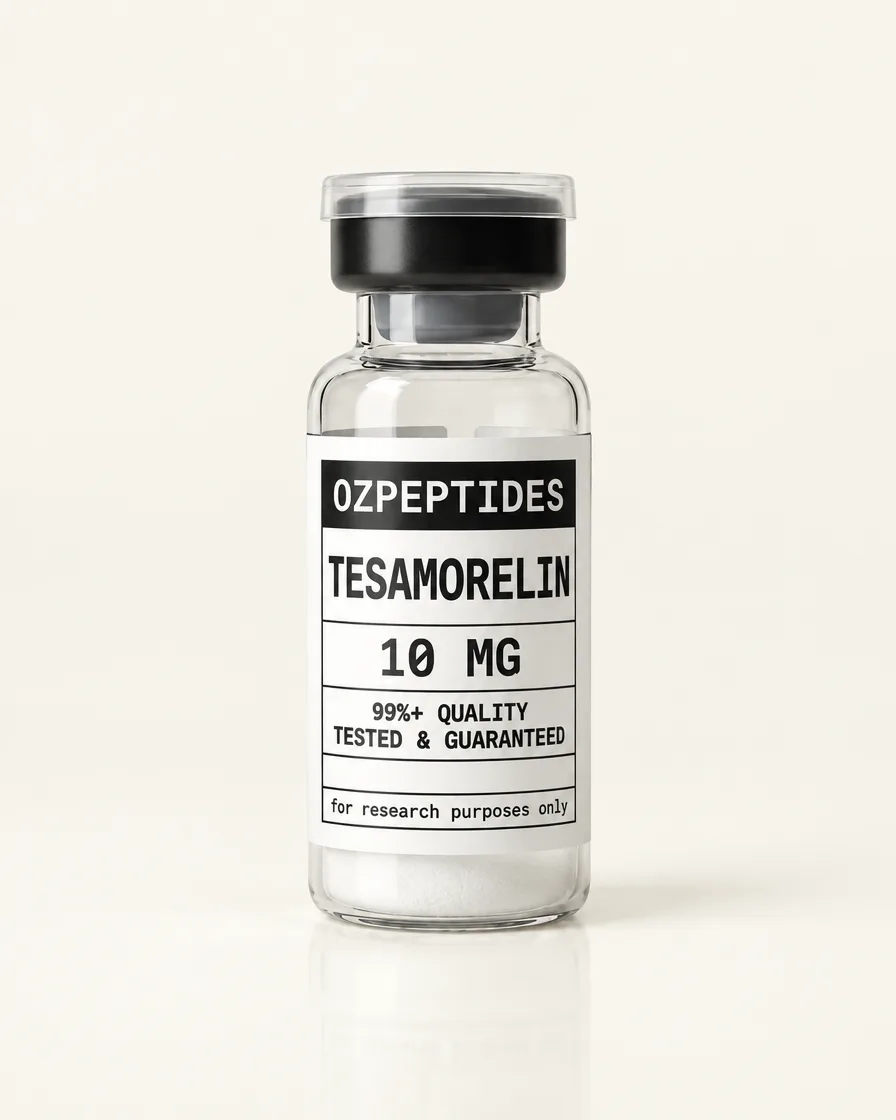
Research-grade tesamorelin, made in Australia.
The hardest synthesis in our growth range, tested accordingly: ≥99% HPLC purity, mass-spec identity, 0 ppm heavy metals, tested batch by batch.
Frequently asked
In the United States, as Egrifta, for HIV-associated lipodystrophy. It is not registered in Australia, and approval does not transfer.
Tesamorelin is the full 44-residue GHRH with an N-terminal modification; CJC-1295 is based on the 29-residue fragment.
Yes. WADA S2 names GHRH and its analogues, prohibited at all times.
Yes, as the downstream marker of increased growth hormone. It was monitored throughout the clinical programme.
A stabilised analogue of growth hormone-releasing hormone that prompts the pituitary to release its own GH.
GH is the hormone itself. Tesamorelin is a secretagogue: it asks the pituitary to release GH, keeping normal feedback and pulsatility.
Tesamorelin is available in 10MG and 20MG.
- Falutz J, et al. Metabolic effects of a growth hormone-releasing factor in patients with HIV. N Engl J Med 2007;357:2359–2370.
- Stanley TL, et al. Effect of tesamorelin on liver fat and visceral fat in HIV-infected patients with abdominal fat accumulation. JAMA 2014;312:380–389.
This guide summarises published research for educational purposes. It is not medical advice. OzPeptides products are sold for research and laboratory use only, not for human consumption. 18+ only.