Key facts
What is the CJC / IPA combo?
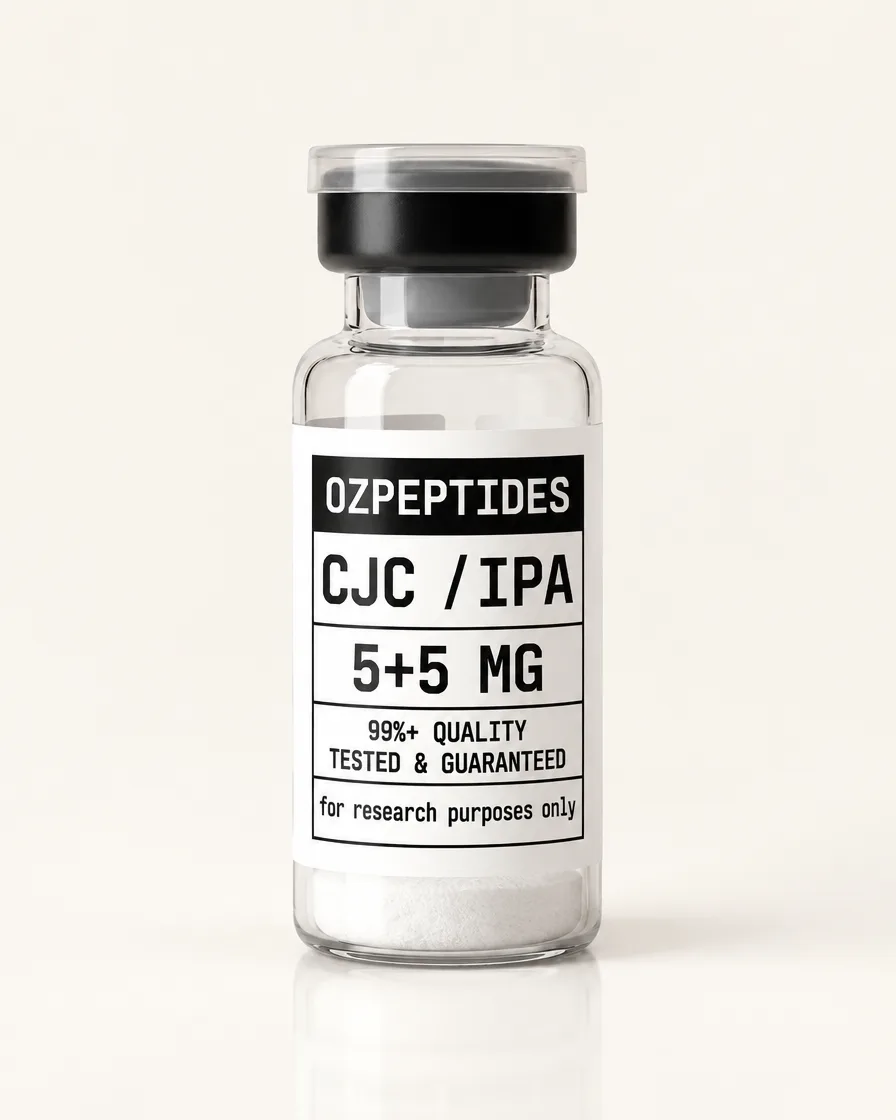
A single vial holding equal amounts of CJC-1295 no DAC and ipamorelin, blended and tested together.
Our strengths are labelled by their parts — 5+5MG means 5MG of each — because with a blend the total is not the useful number. Both are short-acting, so the pairing is used in pulse studies rather than for sustained elevation. Blending them in one lyophilised vial means a single reconstitution, and the finished product tested as one.
Why are these two combined?
They act on separate receptors, and published work reports GHRH analogues and ghrelin agonists produce a larger combined GH response than either alone.
A GHRH analogue signals the somatotroph directly to release GH. A ghrelin receptor agonist acts through GHS-R1a and also suppresses somatostatin, the brake on GH release. Pressing the accelerator while easing the brake is the mechanistic argument, and synergy between GHRH and GHS compounds is reported in the endocrinology literature. Ipamorelin is the preferred partner because it is selective — it does not carry the cortisol and prolactin effects of the older GHRPs.
What is the combination studied for?
Growth hormone secretion physiology, pituitary reserve, and pulsatility research.
The underlying pharmacology of GHRH plus GHS combinations is documented in clinical endocrinology, including their use in testing pituitary GH reserve. Research on this specific commercial pairing is far thinner, and the honest position is that the rationale rests on the pharmacology of the classes rather than on trials of the blend.
Is the combo approved in Australia?
No. Both components are prohibited in sport and neither is registered.
GH secretagogues, including GHRH analogues and ghrelin receptor agonists, are prohibited by WADA under S2 at all times. Neither compound is registered in Australia. OzPeptides supplies the combo for in-vitro and laboratory research only, 18+, not for human consumption.
How is the blend quality verified?
Both peptides confirmed by mass spectrometry, purity by HPLC, heavy metals screened.
A blend labelled 5+5MG has to actually be 5 and 5 — the ratio is the product. We prepare it by weight in our own Australian lab and test the finished blend rather than the inputs, so the batch record describes what is in your vial: identity of both peptides, ≥99% HPLC purity, 0 ppm heavy metals.
Why are these two combined?
They act on different arms of the same system. CJC-1295 acts on the GHRH receptor; ipamorelin on the ghrelin receptor, which also reduces somatostatin tone.
Growth hormone release is governed by an accelerator and a brake — GHRH promotes, somatostatin restrains. A GHRH analogue presses the accelerator; a ghrelin receptor agonist does that and eases the brake at the same time. Doing both is the mechanistic argument for the pairing, and it is why the question about these two compounds is rarely "which one". Class-level synergy between GHRH and the growth hormone-releasing peptides has been documented since Bowers and colleagues reported it in 1990.
Is there a trial of this blend?
No. The synergy between the two classes is documented, and combined administration is used clinically to test pituitary reserve, but the commercial blend itself has not been trialled.
This is the distinction the market most often collapses. Class-level evidence describes what a GHRH analogue plus a growth hormone-releasing peptide do together in a clinical testing protocol; it does not describe this specific pairing at this specific ratio as a product. Reading it the other way round — as though the blend had been tested — is the common overstatement. The mechanistic reasoning is sound and it is reasoning, not a result.
How does the growth hormone axis work?
GHRH from the hypothalamus prompts release from the pituitary, somatostatin restrains it, and IGF-1 from the liver feeds back to restrain it further.
Understanding the loop is what separates a secretagogue from growth hormone itself. Because a secretagogue acts on the pituitary rather than replacing the hormone, the somatostatin brake and the IGF-1 feedback stay intact, and release stays pulsatile. That matters: sustained elevation downregulates receptors and is associated with the adverse-effect profile of exogenous growth hormone, while pulsatility is the physiological pattern. It also caps what any secretagogue can do — the pituitary can only release what it holds, so the ceiling is the gland's own capacity rather than the amount administered.
Which CJC-1295 is in the blend?
The DAC-free version, modified GRF(1-29), which clears in around half an hour and produces a pulse rather than sustained elevation.
This matters more in a blend than anywhere else, because the entire rationale for pairing a GHRH analogue with a secretagogue is about a coordinated pulse. A long-acting DAC version would produce sustained receptor occupancy, which is a different pharmacological proposition and works against the pulsatility argument. A supplier who does not specify which version is in a blend is leaving out the thing that determines what the product is, and only mass spectrometry settles it — the DAC linker changes the molecular weight.
Why ipamorelin rather than GHRP-6?
Because ipamorelin is selective. GHRP-6 and GHRP-2 raise cortisol, prolactin and appetite alongside growth hormone; ipamorelin was developed to remove that.
The 1998 Novo Nordisk characterisation describes ipamorelin as the first selective growth hormone secretagogue, with release comparable to GHRP-6 without the collateral hormone response. In a blend intended to probe the growth hormone axis, those collateral effects would be confounds rather than side effects, which is precisely why ipamorelin rather than the older GHRPs became the standard partner for a GHRH analogue.
How should the milligram figure on the blend be read?
As two separate amounts. We label the blend by its parts — 5+5MG and 10+10MG — because with a combination the per-compound figure is the one that means something.
A blend quoted only as a total leaves out the information any calculation needs, and it makes price-per-milligram comparisons against single compounds meaningless, since the milligrams are not of the same thing. Labelling by component also makes the ratio checkable against the certificate. Ours are prepared by weight in our own lab and the finished blend is tested, so the ratio certified is the ratio in the vial rather than the ratio intended.
Is the blend prohibited in sport?
Yes, on both counts. WADA S2 covers GHRH analogues and ghrelin receptor agonists alike, prohibited at all times, in and out of competition.
A blend inherits the status of everything in it, and here both components fall under the same section of the Prohibited List. Anti-doping laboratories screen specifically for growth hormone secretagogues. Neither compound is approved for human therapeutic use anywhere, which would engage S0 independently. There is no version of this blend permissible for an athlete subject to the Code.
How is the blend reconstituted and stored?
As one vial. Bacteriostatic water directed down the side, swirled not shaken, refrigerated and kept dark, with a practical window of weeks.
The advantage of a blend is single-vial handling; the risk is that one handling error affects both peptides at once, and foaming gives no indication of which component was damaged. CJC-1295 is the longer of the two at 29 residues and the more sensitive to agitation, so the swirl-not-shake rule is worth taking seriously here. We prepare and test the blend in Blacktown, NSW, at ≥99% HPLC purity with 0 ppm heavy metals, with both components confirmed by mass spectrometry in the vial as sold.
CJC / IPA combo, blended and tested in Australia.
The ratio is the product, so we test the finished blend, not the inputs: both peptides confirmed, ≥99% HPLC purity, 0 ppm heavy metals.
Frequently asked
No. Class-level synergy between GHRH analogues and growth hormone-releasing peptides is documented, but the commercial blend has not been studied.
The DAC-free version, modified GRF(1-29). A long-acting DAC version would work against the pulsatility rationale for pairing them.
Ipamorelin is selective: it does not carry the cortisol, prolactin and appetite response the older GHRPs produce, which would be confounds.
The amount of each component. With a combination the per-compound figure is the one that means something, so we label by parts rather than by total.
CJC-1295 without DAC and ipamorelin, pre-blended in one vial in equal amounts.
They act on different receptors — one signals GH release, the other also suppresses somatostatin, the brake on it.
Yes. Both components fall under WADA S2.
- Bowers CY, et al. Growth hormone-releasing peptide and GHRH act synergistically to release growth hormone. J Clin Endocrinol Metab 1990;70:975–982.
- Raun K, et al. Ipamorelin, the first selective growth hormone secretagogue. Eur J Endocrinol 1998;139:552–561.
This guide summarises published research for educational purposes. It is not medical advice. OzPeptides products are sold for research and laboratory use only, not for human consumption. 18+ only.