Key facts
What is CJC-1295 without DAC?
It is the first 29 amino acids of GHRH — the receptor-binding portion — with four substitutions for stability, and no albumin-binding group.
GHRH(1-29) retains full activity of the 44-residue hormone, so the shorter sequence is the practical starting point. The four substitutions protect against enzymatic breakdown, chiefly DPP-4 cleavage at the N-terminus. The naming in the market is genuinely confusing: "CJC-1295" originally referred to the version with the drug affinity complex, and "no DAC" is a different pharmacological profile entirely despite the shared name.
How does it work?
It binds the pituitary GHRH receptor and triggers a short burst of growth hormone release, then clears.
The short half-life is deliberate. Growth hormone is normally released in pulses, and continuous elevation is not what the physiology looks like — sustained exposure downregulates receptors and is associated with the adverse-effect profile of exogenous GH. A brief secretagogue pulse leaves the somatostatin brake and IGF-1 feedback intact, which is the research rationale for preferring the DAC-free version in pulsatility studies.
What is CJC-1295 studied for?
Growth hormone secretion research, usually alongside a ghrelin receptor agonist.
Published human data specifically on the DAC-free version is thin; the better-documented compound is CJC-1295 with DAC, which was studied in early clinical work reporting sustained GH and IGF-1 elevation. Most laboratory interest in modified GRF(1-29) concerns its combination with a ghrelin-receptor agonist such as ipamorelin, because the two act through separate receptors and the combined effect is reported as greater than either alone.
Is CJC-1295 approved in Australia?
No, and GH secretagogues are prohibited in sport.
Neither version is registered in Australia. WADA prohibits growth hormone secretagogues including GHRH analogues under S2, at all times. OzPeptides supplies CJC-1295 no DAC for in-vitro and laboratory research only, 18+, not for human consumption.
How is research-grade CJC-1295 quality verified?
HPLC purity, mass-spec identity and heavy-metal screening per batch.
Mass confirmation matters here more than usual because of the naming problem: with and without DAC differ by an added maleimide linker, and a supplier mislabelling one as the other would not be visible in the vial. Mass spectrometry settles it. Every batch is made and tested in our Australian lab at ≥99% HPLC purity with 0 ppm heavy metals.
What is the DAC, and why does the name mislead?
CJC-1295 originally described a version carrying a drug affinity complex — a maleimide linker binding albumin, extending the half-life to days. The version sold as "no DAC" is a different compound.
This is the most confused label in the peptide market and it matters because the published data belongs to one version. Early clinical work on the DAC version reported sustained elevation of growth hormone and IGF-1 over days, and that is the data most often cited for "CJC-1295" generally. The DAC-free version — modified GRF(1-29) — clears in around half an hour, produces a pulse, and leaves the somatostatin brake and IGF-1 feedback intact. Two pharmacological propositions sharing one name, and data on one does not describe the other.
What is CJC-1295 built from?
GHRH(1-29), the receptor-binding portion of the 44-residue hormone, with four amino acid substitutions that resist enzymatic breakdown.
GHRH(1-29) retains full activity despite being two-thirds the length of the hormone, which is why nearly every GHRH analogue is built on it rather than the full sequence. The substitutions address the main degradation routes, chiefly DPP-4 cleavage at the N-terminus, which destroys unmodified GHRH within minutes. That is where "modified GRF(1-29)" comes from as an alternative name, and it is the more accurate one for the DAC-free product.
How does the growth hormone axis work?
GHRH from the hypothalamus prompts release from the pituitary, somatostatin restrains it, and IGF-1 from the liver feeds back to restrain it further.
Understanding the loop is what separates a secretagogue from growth hormone itself. Because a secretagogue acts on the pituitary rather than replacing the hormone, the somatostatin brake and the IGF-1 feedback stay intact, and release stays pulsatile. That matters: sustained elevation downregulates receptors and is associated with the adverse-effect profile of exogenous growth hormone, while pulsatility is the physiological pattern. It also caps what any secretagogue can do — the pituitary can only release what it holds, so the ceiling is the gland's own capacity rather than the amount administered.
Why does the no-DAC version suit pulsatility research?
Because a half-hour clearance produces a pulse rather than sustained elevation, which is the physiological pattern the axis normally operates in.
Sustained receptor occupancy downregulates receptors and is associated with the adverse-effect profile of exogenous growth hormone; pulsatile release is how the system works naturally. A short-acting GHRH analogue therefore acts as a probe that works with the axis rather than overriding it, which is the specific research argument for the DAC-free version over the long-acting one. It is also why the two are not interchangeable in a study design despite sharing a name.
Why is CJC-1295 usually paired with ipamorelin?
Because they act on different arms of the same system: CJC-1295 on the GHRH receptor, ipamorelin on the ghrelin receptor, which also reduces somatostatin tone.
Pressing the accelerator while easing the brake is the mechanistic argument, and class-level synergy between GHRH and the growth hormone-releasing peptides has been documented since Bowers and colleagues reported it in 1990. Combined administration is used clinically to test pituitary growth hormone reserve. What does not exist is a trial of the specific commercial blend — the reasoning is mechanism and class data, not a study of the vial, and stating it the other way round is the common overstatement here.
Is CJC-1295 prohibited in sport?
Yes. WADA S2 covers GHRH and its analogues, prohibited at all times, in and out of competition.
The class is named explicitly on the Prohibited List and anti-doping laboratories screen for it. Neither version of CJC-1295 is approved for human therapeutic use anywhere, which would place it under S0 in any case. Any athlete subject to the World Anti-Doping Code should treat it as prohibited without qualification.
How is CJC-1295 stored and reconstituted?
Lyophilised and cold for storage; bacteriostatic water for reconstitution, refrigerated, with a practical window of weeks.
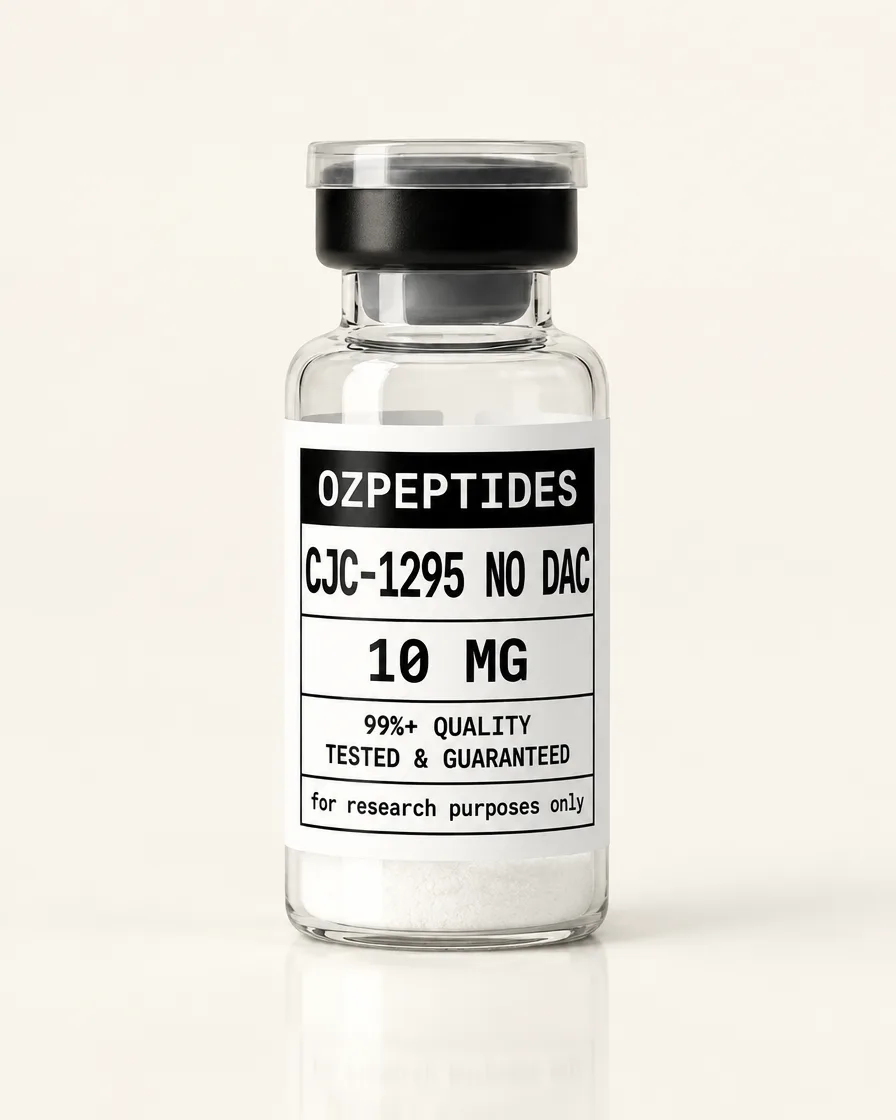
A 29-residue peptide is long enough that agitation matters: direct the diluent down the side of the vial and swirl rather than shake, since foaming indicates denatured peptide. Bacteriostatic water rather than sterile is what makes a multi-draw vial possible, and the reconstituted vial should be refrigerated and kept out of light. We stock CJC-1295 no DAC in 10MG vials; 10MG in 2ML gives 5MG/ML.
What should be checked in a CJC-1295 vial?
Which version it is, by mass spectrometry. The DAC linker changes the molecular weight, so the two are unambiguously distinguishable — and only by mass.
A supplier who cannot say whether their CJC-1295 carries the DAC is telling you something about how the product is sourced. Beyond that, the usual checks apply: purity by HPLC, fill weight on the certificate, and heavy-metal screening. We make CJC-1295 no DAC in Blacktown, NSW, at ≥99% HPLC purity with 0 ppm heavy metals, and the label says which version it is because that is the material fact about the vial.
Research-grade CJC-1295 no DAC, made in Australia.
The one compound where the name alone tells you nothing — so we confirm the molecule. ≥99% HPLC purity, mass-spec identity, 0 ppm heavy metals.
Frequently asked
The DAC is a linker that binds albumin and extends the half-life to days. Without it, clearance is around half an hour. They are different pharmacological propositions.
The DAC-free version is, yes. That is the more accurate name for it.
Yes. WADA S2 names GHRH and its analogues, prohibited at all times, and laboratories screen for the class.
By mass spectrometry. The DAC linker changes the molecular weight, and nothing else distinguishes them.
A 29-amino-acid GHRH analogue with four stabilising substitutions and no albumin-binding complex, giving a short pulse of GH release.
It produces a pulse rather than continuous elevation, which is closer to how GH is normally secreted.
They act on different receptors — GHRH and ghrelin — so the combination is studied for a larger combined response.
CJC-1295 no DAC is available in 10MG.
- Teichman SL, et al. Prolonged stimulation of growth hormone and insulin-like growth factor I secretion by CJC-1295, a long-acting analog of GHRH, in healthy adults. J Clin Endocrinol Metab 2006;91:799–805.
- World Anti-Doping Agency. Prohibited List — Section S2, growth hormone releasing factors.
This guide summarises published research for educational purposes. It is not medical advice. OzPeptides products are sold for research and laboratory use only, not for human consumption. 18+ only.