Key facts
What is PT-141?
PT-141 is a cyclic peptide that came out of melanotan research when an unexpected effect proved more interesting than the intended one.
It is a metabolite of melanotan II, identified when work on tanning peptides at the University of Arizona produced effects on sexual arousal that had nothing to do with pigmentation. Development split at that point: the pigmentation line continued as the melanotans, and this one was pursued separately as bremelanotide, eventually reaching approval in the United States for hypoactive sexual desire disorder in premenopausal women.
How does PT-141 work?
It acts centrally on melanocortin receptors, chiefly MC4R in the brain, rather than on the vascular system.
That distinction matters when comparing it to the PDE5 inhibitor class: those compounds act on blood flow in peripheral tissue, while melanocortin agonism acts on arousal pathways in the central nervous system. MC4R is also involved in appetite regulation, which is why melanocortin compounds have a complicated pharmacology and why selectivity between receptor subtypes is an active research question.
What is PT-141 studied for?
Sexual arousal and desire research, and melanocortin receptor pharmacology more broadly.
The clinical programme that led to US approval covered hypoactive sexual desire disorder in premenopausal women across randomised trials. Earlier work looked at erectile dysfunction, including in people who did not respond to PDE5 inhibitors; that line was discontinued at the time over blood pressure signals with intranasal delivery. Laboratory use today is largely about receptor selectivity and central melanocortin signalling.
Is PT-141 approved in Australia?
No. It is approved in the United States but is not registered in Australia.
An approval in another country is not an approval here, and research-grade bremelanotide is not the approved product in any case — the US medicine is a specific formulation dispensed on prescription. OzPeptides supplies PT-141 for in-vitro and laboratory research only, 18+, not for human consumption.
How is research-grade PT-141 quality verified?
HPLC purity, mass-spec identity and heavy-metal screening per batch.
PT-141 is a cyclic peptide, and the ring closure is part of its identity — a linear version of the same sequence is a different molecule with different behaviour, and it is a cheaper thing to make. Mass spectrometry distinguishes them. Every OzPeptides batch is made and tested here at ≥99% HPLC purity with 0 ppm heavy metals and the results recorded against the batch on your vial.
Where did PT-141 come from?
Out of melanotan II research. Effects on sexual arousal unrelated to pigmentation were traced to a metabolite acting at MC4R, and that metabolite was developed separately as bremelanotide.
The discovery is a good illustration of how promiscuous receptor binding produces unexpected findings. MT-2 is cyclised and potent, and the rigidity that gives it potency also lets it fit MC3R and MC4R alongside the MC1R pigmentation receptor. Researchers observing arousal effects that had nothing to do with pigment traced them to an MC4R-active metabolite, and that compound — bremelanotide, PT-141 — was taken forward on its own. It is one of the few compounds in this catalogue whose development path ran from grey-market observation to registered medicine rather than the reverse.
How does PT-141 work?
Through melanocortin receptors in the central nervous system, chiefly MC4R — a neural pathway rather than a vascular one.
This is the distinction that matters most in understanding the compound. PDE5 inhibitors act on vascular smooth muscle and blood flow; PT-141 acts centrally, on melanocortin signalling in the hypothalamus and related structures involved in sexual arousal. Two different mechanisms, two different classes of compound, and the difference explains why the research questions asked about them are not the same. It also means the reported effect profile — nausea and flushing prominent among them — follows from central melanocortin activity rather than from anything vascular.
Is PT-141 an approved medicine?
As bremelanotide it is approved in the United States under the brand name Vyleesi, for hypoactive sexual desire disorder in premenopausal women. It is not registered in Australia.
That American registration is real and is the strongest evidence any compound in the vitality category has, but it does not transfer. A drug approved in one jurisdiction is not approved in another, and bremelanotide is not registered in Australia. The registered product is also a specific formulation with an approved label, a leaflet and a manufacturer standing behind each batch — a different thing from a lyophilised research vial, and not interchangeable with one. OzPeptides supplies PT-141 for in-vitro and laboratory research only.
Does PT-141 cause tanning?
It is selective enough that pigmentation is not its primary activity, but it comes from the melanocortin family and darkening has been reported in the literature.
MC4R is the target, MC1R is the pigmentation receptor, and PT-141's selectivity is better than MT-2's — which is the entire reason it could be developed as a distinct medicine. Selectivity is a matter of degree rather than an absolute, though, and skin darkening appears in the reported effects. Anyone reading across from the melanotan compounds should hold both facts: PT-141 is not a tanning peptide, and it is not entirely free of the family's pigment activity either.
Is PT-141 prohibited in sport?
It is not currently named on the WADA Prohibited List. It is approved for human use in the United States, so the S0 catch-all does not obviously apply.
That is a statement about the current list rather than a permission, and the list is revised annually. Anti-doping rules also concern the source and the form of anything an athlete uses: research-grade material is not a medicine, carries no therapeutic use exemption pathway, and is not supplied for human use. Any athlete subject to the World Anti-Doping Code should check the current list directly rather than rely on a supplier's summary, including this one.
How is PT-141 stored and reconstituted?
Lyophilised and cold for storage; bacteriostatic water for reconstitution, refrigerated and dark, with a practical window of weeks.
PT-141 is a cyclic peptide and more robust than a linear one of similar length, but the handling rules are unchanged. Bacteriostatic water rather than sterile is what makes a multi-draw vial possible, since the benzyl alcohol inhibits bacterial growth. Direct the diluent down the side of the vial and swirl rather than shake — foaming indicates denatured peptide. A 10MG vial in 2ML gives 5MG/ML, so a 0.1ML draw is 500mcg; the calculator carries the arithmetic per strength.
What should be checked in a PT-141 vial?
Identity by mass spectrometry, purity by HPLC and fill weight. PT-141, MT-1 and MT-2 are routinely confused with one another in the grey market.
Three melanocortin peptides with overlapping names and different receptor profiles is a recipe for mislabelling, and a mislabelled vial does not produce wrong results so much as results about a different compound. Mass spectrometry resolves which is present; an HPLC purity figure can read 99% on any of them. The cyclisation step is also one that can be skipped in a cheap synthesis, producing a linear peptide of similar mass and different behaviour. We make PT-141 in Blacktown, NSW, at ≥99% HPLC purity with 0 ppm heavy metals.
How does PT-141 compare with the melanotans?
Same family, different receptor emphasis and a completely different research context. MT-1 targets MC1R and pigmentation; MT-2 is promiscuous; PT-141 is MC4R-directed.
The three are best held apart by what each was developed for. MT-1 became afamelanotide, a registered medicine for a rare light-sensitivity condition. MT-2 never entered formal development and carries well-documented safety concerns. PT-141 became bremelanotide, approved in the United States for a sexual desire indication. One family, three outcomes, and three different bodies of evidence — which is why the comparison pages treat MT-1 against MT-2 separately from anything involving PT-141.
PT-141 vs MT-1 vs MT-2
Research-grade PT-141, made in Australia.
A cyclic peptide where the ring is the point, confirmed by mass spec: ≥99% HPLC purity, 0 ppm heavy metals, tested batch by batch.
Frequently asked
Yes. Bremelanotide is approved in the United States as Vyleesi; PT-141 is the same molecule, and research-grade material is not that product.
No. PDE5 inhibitors act on vascular smooth muscle; PT-141 acts centrally through melanocortin receptors, chiefly MC4R.
From melanotan II research. Arousal effects unrelated to pigment were traced to an MC4R-active metabolite, developed separately.
No. It is not registered here, and approval in the United States does not transfer.
Bremelanotide — a melanocortin receptor agonist peptide derived from melanotan II research, developed for sexual function.
No. It is a metabolite of it, developed separately, and does not carry the same pigmentation activity.
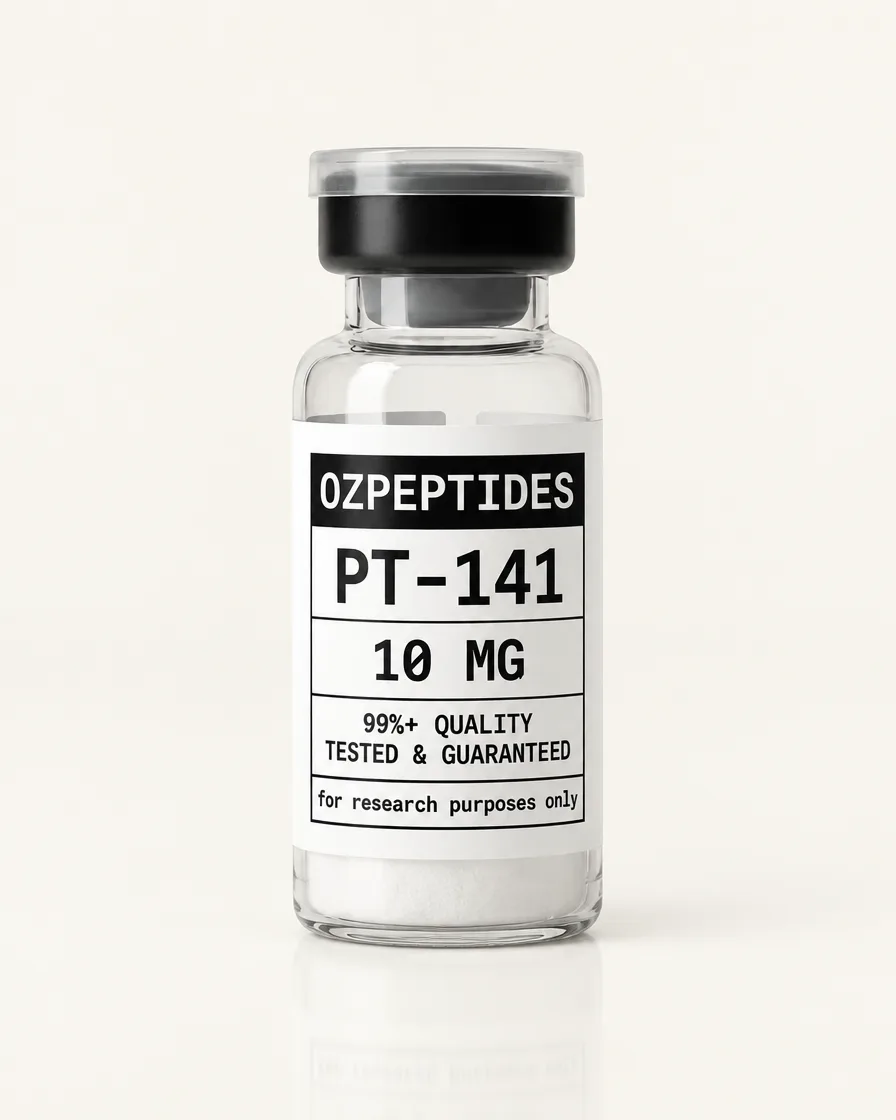
PT-141 is available in 10MG.
- Kingsberg SA, et al. Bremelanotide for the Treatment of Hypoactive Sexual Desire Disorder: Two Randomized Phase 3 Trials. Obstet Gynecol 2019;134:899–908.
- Molinoff PB, et al. PT-141: a melanocortin agonist for the treatment of sexual dysfunction. Ann N Y Acad Sci 2003;994:96–102.
This guide summarises published research for educational purposes. It is not medical advice. OzPeptides products are sold for research and laboratory use only, not for human consumption. 18+ only.