Key facts
What is MT-1?
MT-1 is a linear analogue of alpha-melanocyte-stimulating hormone, modified for stability and selective for the MC1R receptor.
Native alpha-MSH is degraded within minutes. MT-1 substitutes two residues to resist that, giving a molecule that keeps the hormone's pigmentation activity with a workable half-life. The route from research compound to registered medicine ran through Clinuvel Pharmaceuticals in Melbourne, which developed it as afamelanotide — a genuinely Australian piece of peptide science, and a rare example of one of these compounds completing the regulatory path.
How does MT-1 work?
It activates MC1R on melanocytes, increasing eumelanin production — the pigment associated with photoprotection.
MC1R activation drives melanogenesis toward eumelanin rather than pheomelanin. Because eumelanin absorbs ultraviolet light more effectively, the research interest is in photoprotection rather than cosmetic tanning. MT-1's selectivity for MC1R over MC3R and MC4R is the main pharmacological difference from MT-2, and it is why its effects are more confined to pigmentation.
What is MT-1 studied for?
Erythropoietic protoporphyria, photoprotection, and pigmentation biology.
The registered indication for afamelanotide is erythropoietic protoporphyria, a rare inherited condition in which sunlight causes severe pain. Trials reported increased pain-free light exposure. Other published work covers polymorphic light eruption and pigmentation research. As a laboratory compound, MT-1 is used in melanocortin receptor pharmacology, where its selectivity makes it a useful tool.
Is MT-1 approved in Australia?
Afamelanotide is a registered medicine in some markets; research-grade MT-1 is not that product and is not a medicine.
The registered product is a controlled-release implant administered by a trained clinician for a diagnosed rare condition — a long way from a lyophilised research vial. OzPeptides supplies MT-1 for in-vitro and laboratory research only, 18+, not for human consumption. Anyone with a light-sensitivity condition should be speaking to a doctor about the registered treatment.
How is research-grade MT-1 quality verified?
HPLC purity, mass-spec identity, heavy-metal screening.
MT-1 and MT-2 are routinely confused in the grey market, and they are different molecules with different receptor profiles — MT-2 is cyclic and shorter, MT-1 linear and selective. Mass spectrometry tells them apart definitively. Every OzPeptides batch is made and tested in Australia at ≥99% HPLC purity with 0 ppm heavy metals and the results recorded against the batch on your vial.
What makes MT-1 different from MT-2 structurally?
MT-1 is linear with two substitutions — norleucine at position 4 and D-phenylalanine at 7. MT-2 is shortened and cyclised, which raises potency and costs selectivity.
Native alpha-MSH is a 13-residue hormone cleared within minutes, and both compounds exist to solve that. MT-1 solves it with substitutions that resist degradation while leaving the molecule's shape close to the original, which is why its receptor preference stays close to the hormone's: MC1R above the rest. MT-2 solves it by cyclisation, locking the peptide into a rigid conformation that resists breakdown and binds more strongly — and that rigid shape fits MC3R and MC4R as well. Potency and promiscuity arrived together, and that is the whole difference between the two.
What is afamelanotide?
MT-1 under its registered name. Clinuvel Pharmaceuticals in Melbourne developed it, and it is registered in several markets for erythropoietic protoporphyria.
This is a rare case of a compound in this catalogue completing the regulatory path, and it is an Australian piece of science. Erythropoietic protoporphyria is an inherited condition in which sunlight causes severe pain, and the registration trials measured pain-free light exposure. The product is a controlled-release implant administered by a trained clinician, which is a long way from a lyophilised research vial and not interchangeable with one. The registration also does not extend to Australia as a research product: MT-1 is not registered in Australia for that use.
What does MC1R activation do to pigment?
It shifts melanin synthesis toward eumelanin — the darker, brown-black pigment — and away from pheomelanin, the red-yellow one.
That shift is the basis of the photoprotection research, because eumelanin absorbs ultraviolet light considerably more effectively than pheomelanin. MC1R gene variants are the main reason some people tan and others burn: loss-of-function variants are strongly associated with fair skin, red hair and poor tanning response. A compound that activates the receptor directly is therefore a way of studying the pathway in cells where the natural signal is weak — the genuinely interesting scientific question under a compound with an unfortunate reputation. It also does not make MT-1 a sunscreen: more eumelanin is not the same as blocking ultraviolet light.
How strong is the MT-1 evidence?
Stronger than anything else in the melanotan family. Afamelanotide went through registration trials with a measured clinical endpoint.
Registration trials are the highest standard of evidence available, and MT-1 has them — for one specific rare condition, in a specific implant formulation, with pain-free light exposure as the endpoint. That is a real and unusual credential. What it does not establish is anything about research-grade MT-1 used in any other context, and reading across from a registered implant for a rare photosensitivity disorder to general pigmentation research is the stretch worth resisting.
Is MT-1 prohibited in sport?
Afamelanotide is approved in some jurisdictions, but research-grade MT-1 has no Australian approval, and the practical answer for athletes is to avoid it.
The melanocortin peptides sit awkwardly in anti-doping terms: one has a registration in some markets, one has none and well-documented safety concerns. The safest reading is that a research vial is not the registered medicine, carries no therapeutic use exemption pathway, and would be difficult to defend. Any athlete subject to the World Anti-Doping Code should check the current list directly and treat unapproved melanocortin peptides as prohibited.
What are the safety concerns with melanotan peptides?
Two: injectable tanning products containing them are unapproved and unassessed, and they can complicate the monitoring of skin lesions.
The first is that the products are unapproved and unassessed. The second is that changes to existing skin lesions may go unnoticed in people using a compound that alters pigmentation. Neither MT-1 nor MT-2 is registered in Australia as a research product. Afamelanotide being registered elsewhere does not change that, because the registered product is a specific implant for a diagnosed rare condition rather than a general-purpose peptide.
How is MT-1 stored and reconstituted?
Lyophilised and cold for storage; bacteriostatic water for reconstitution, refrigerated and kept dark, with a practical window of weeks.
Light sensitivity deserves more attention here than with most peptides — a compound studied for its interaction with ultraviolet light is not one to leave on a bench in daylight. Otherwise the handling is standard: bacteriostatic water rather than sterile for a multi-draw window, diluent directed down the side of the vial, swirl rather than shake since foaming indicates denatured peptide, and refrigerate once mixed. We stock MT-1 in 10MG vials.
What should be checked in an MT-1 vial?
Identity by mass spectrometry above all. MT-1, MT-2 and PT-141 have overlapping names, different receptor profiles, and are routinely confused in the grey market.
A mislabelled melanocortin vial does not produce wrong results so much as results about a different compound, which is a subtler and more damaging failure than a bad purity figure. Mass spectrometry resolves which peptide is present; an HPLC trace can read 99% on any of the three. We make MT-1 in Blacktown, NSW, at ≥99% HPLC purity with 0 ppm heavy metals, and supply it for in-vitro and laboratory research only, to buyers aged 18 and over.
Research-grade MT-1, made in Australia.
Confused with MT-2 everywhere else; confirmed by mass spec here. ≥99% HPLC purity, 0 ppm heavy metals, tested batch by batch.
Frequently asked
Yes, the same peptide. The registered product is a controlled-release implant for a rare light-sensitivity condition, not interchangeable with a research vial.
Clinuvel Pharmaceuticals in Melbourne. It is registered in several markets for erythropoietic protoporphyria.
No. Increased eumelanin absorbs ultraviolet light more effectively than pheomelanin, but that is not the same as blocking it.
It stays linear, so its shape remains close to alpha-MSH and its receptor preference stays with MC1R. Cyclisation is what makes MT-2 promiscuous.
Melanotan I — a stabilised analogue of alpha-MSH, selective for the MC1R pigmentation receptor.
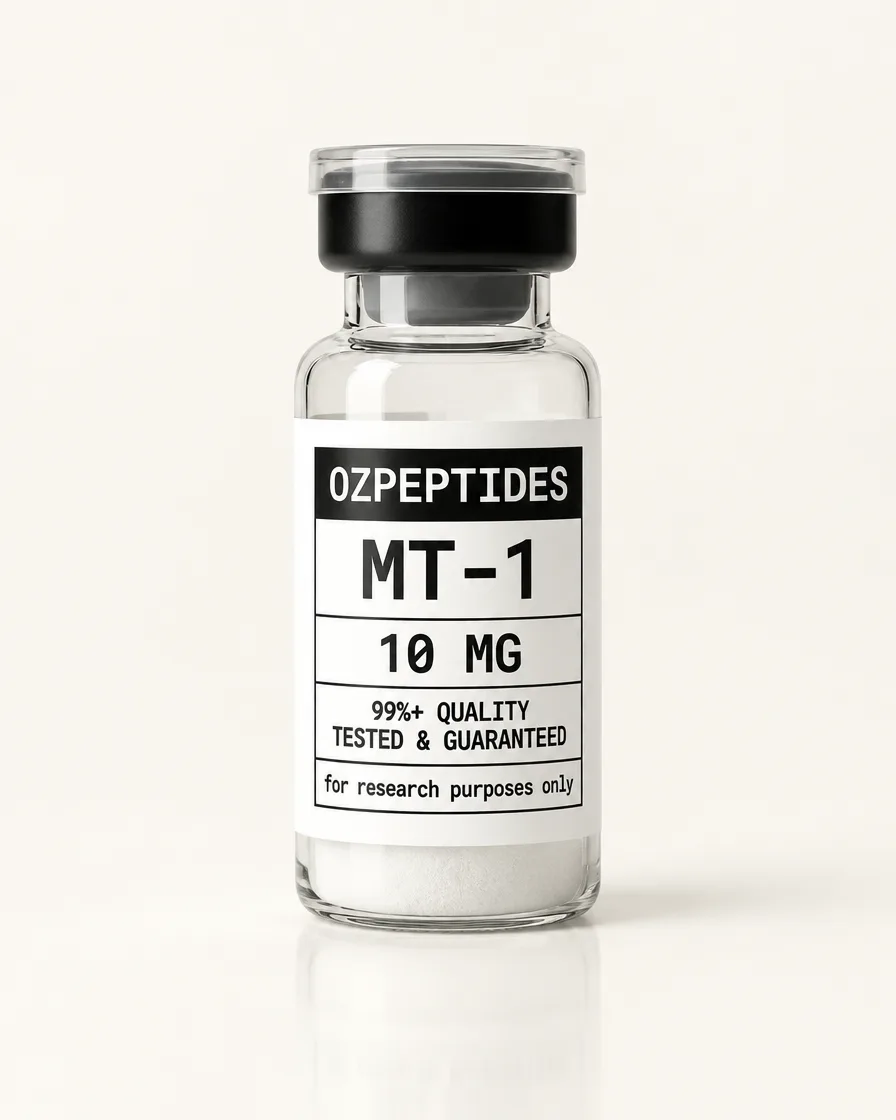
MT-1 is available in 10MG.
- Langendonk JG, et al. Afamelanotide for Erythropoietic Protoporphyria. N Engl J Med 2015;373:48–59.
- Dorr RT, et al. Evaluation of melanotan-I in humans: a potential photoprotective agent. Life Sci 1996;58:1777–1784.
This guide summarises published research for educational purposes. It is not medical advice. OzPeptides products are sold for research and laboratory use only, not for human consumption. 18+ only.