Key facts
What is kisspeptin?
Kisspeptin is the peptide product of the KISS1 gene, acting on the KISS1R receptor to trigger release of GnRH from the hypothalamus.
It was first identified as a metastasis-suppressor gene — the original name, metastin, comes from that — before its reproductive role was recognised. The turning point was genetic: people with inactivating mutations in the receptor were found to have failure of puberty, which placed kisspeptin upstream of the entire hypothalamic-pituitary-gonadal axis. Several fragment lengths are studied, with kisspeptin-10 and kisspeptin-54 the most common.
How does kisspeptin work?
It acts on KISS1R-expressing neurons in the hypothalamus, driving pulsatile GnRH release, which then drives LH and FSH from the pituitary.
The pulsatility matters: continuous GnRH signalling desensitises the pituitary, while pulsatile signalling sustains it — the pharmacological basis of how GnRH agonists can be used to suppress rather than stimulate. Kisspeptin neurons in the arcuate nucleus are considered a key part of the pulse generator, and they also integrate signals about energy status, which links reproductive function to metabolic state.
What is kisspeptin studied for?
Reproductive endocrinology, puberty, fertility research, and hypothalamic amenorrhoea.
Published human research includes work using kisspeptin to trigger oocyte maturation in IVF protocols as an alternative to hCG, studies in hypothalamic amenorrhoea, and imaging work on responses to sexual and emotional stimuli. That is a real clinical research programme, largely from UK groups, and considerably better founded than most compounds in this range — though still investigational.
Is kisspeptin approved in Australia?
No. It is investigational and not registered in Australia.
No kisspeptin product is registered as a medicine in Australia. As a peptide hormone affecting the reproductive axis, it also falls within the WADA S2 category for athletes. OzPeptides supplies kisspeptin for in-vitro and laboratory research only, 18+, not for human consumption.
How is research-grade kisspeptin quality verified?
HPLC purity and mass-spec identity per batch, plus heavy-metal screening.
Because kisspeptin is supplied in several fragment lengths that share a name, identity confirmation is the difference between knowing and assuming what is in the vial — kisspeptin-10 and kisspeptin-54 are not interchangeable in a protocol. Every OzPeptides batch is made and tested here at ≥99% HPLC purity with 0 ppm heavy metals and the results recorded against the batch.
Where does the name kisspeptin come from?
From KISS1, the gene that encodes it — originally identified as a metastasis suppressor and named after Hershey Kisses, made in Hershey, Pennsylvania where the work was done.
The naming is a genuine piece of scientific trivia and it explains an otherwise baffling name. KISS1 was described in 1996 as a suppressor of metastasis in melanoma, and the peptide products of the gene were initially called metastin. Their role in reproductive endocrinology was discovered later and independently, when mutations in the receptor GPR54 were found in patients with hypogonadotropic hypogonadism. A gene named for a chocolate, identified for cancer biology, turning out to govern the onset of puberty is one of the odder paths in modern endocrinology.
How does kisspeptin work?
It acts on the KISS1R receptor, formerly GPR54, on hypothalamic neurons, stimulating GnRH release — the top of the reproductive hormone axis.
The hierarchy matters for understanding what kind of tool this is. GnRH from the hypothalamus drives LH and FSH release from the pituitary, which in turn drive gonadal steroid production. Kisspeptin sits above GnRH, which makes it a regulator of the regulator, and it is the point at which metabolic and environmental signals are thought to gate reproductive function. That position is why it became interesting: it is the switch rather than one of the downstream levers.
What did the human genetics show?
Loss-of-function mutations in the kisspeptin receptor cause failure to enter puberty, which established the peptide as essential to reproductive development.
Human genetics is the strongest evidence in kisspeptin biology and it is unusually clean: two groups independently reported in 2003 that GPR54 mutations produced hypogonadotropic hypogonadism, and the phenotype is unambiguous. Unlike most compounds in this catalogue, where mechanism is inferred from administration studies, kisspeptin's necessity was established by what happens when it does not work. That is a different and stronger kind of evidence, and it is why the field took the peptide seriously from the start.
What is kisspeptin studied for?
Reproductive endocrinology — the physiology of puberty and fertility — and more recently as a diagnostic tool and in work on emotional and sexual brain responses.
Published human work includes its use to trigger oocyte maturation in IVF protocols, explored as an alternative with a different safety profile to conventional triggers, and imaging studies looking at limbic responses. The clinical work is mostly investigator-led and exploratory rather than a registrational programme. No kisspeptin product is approved anywhere, which is the practical position despite a comparatively serious research record.
Is kisspeptin prohibited in sport?
It has no approval for human therapeutic use anywhere, which places it under the WADA S0 catch-all, and its position above the reproductive axis invites scrutiny.
Substances affecting the hypothalamic-pituitary-gonadal axis draw particular attention in anti-doping, because that axis governs endogenous steroid production. Kisspeptin has no regulatory approval, which is sufficient on its own for S0 to apply. Athletes subject to the World Anti-Doping Code should treat it as prohibited at all times, and the absence of a specific named listing is not an exemption.
Which kisspeptin is in the vial?
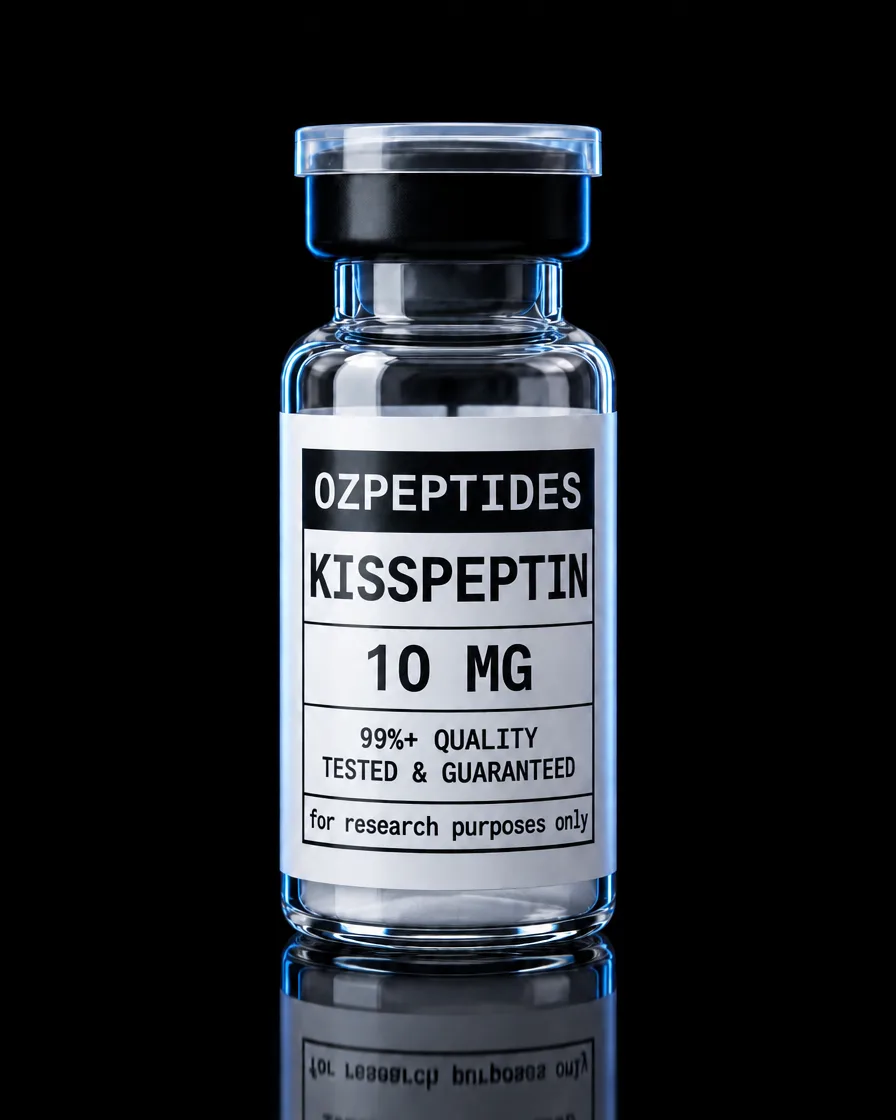
Kisspeptin-10 is the commonly supplied fragment. The gene product is processed into several lengths — kisspeptin-54, -14, -13 and -10 — that share a C-terminal region.
All the variants share the C-terminal decapeptide that binds the receptor, which is why kisspeptin-10 retains activity, but they differ substantially in mass and in clearance. A supplier who does not specify which variant is in the vial is leaving out the thing that determines what the material is, and mass spectrometry is what settles it. Kisspeptin-54 and kisspeptin-10 are not interchangeable in a study design, and the published literature uses both.
How is kisspeptin stored and reconstituted?
Lyophilised and cold for storage; bacteriostatic water for reconstitution, refrigerated, with a practical window of weeks.
Kisspeptin-10 is a short peptide and dissolves readily. The standard handling applies: bacteriostatic water rather than sterile for a multi-draw window, diluent directed down the side of the vial, swirl rather than shake since foaming indicates denatured peptide, and refrigerate and keep out of light once mixed. The reconstitution calculator carries the arithmetic for the strengths we stock.
What should be checked in a kisspeptin vial?
Which variant it is, confirmed by mass spectrometry, then purity by HPLC and fill weight.
Variant identity is the check that matters most here, because kisspeptin-10 and kisspeptin-54 are both legitimate compounds with different masses, different clearance and different published literatures — and a purity figure cannot distinguish them. Beyond that the usual failure modes apply: underfilling, which purity never catches, and relabelled imported stock with a certificate from another batch. We make kisspeptin in Blacktown, NSW, at ≥99% HPLC purity with 0 ppm heavy metals.
Research-grade kisspeptin, made in Australia.
Sold in several fragment lengths across the market, confirmed by mass spec here: ≥99% HPLC purity, 0 ppm heavy metals, tested batch by batch.
Frequently asked
After KISS1, the gene that encodes it, named in reference to Hershey Kisses at the Pennsylvania lab where the gene was identified as a metastasis suppressor.
By human genetics. Loss-of-function mutations in the receptor cause failure to enter puberty, reported independently by two groups in 2003.
Kisspeptin-10 is the commonly supplied fragment. The variants share a C-terminal region but differ in mass and clearance and are not interchangeable.
A human peptide hormone, the product of the KISS1 gene. It acts on KISS1R on hypothalamic neurons to stimulate GnRH release, sitting at the top of the reproductive hormone axis.
It was first identified as a metastasis-suppressor gene product; its reproductive role was recognised later.
Yes — including IVF trigger protocols and studies in hypothalamic amenorrhoea. It remains investigational.
Kisspeptin is available in 10MG.
- de Roux N, et al. Hypogonadotropic hypogonadism due to loss of function of the KiSS1-derived peptide receptor GPR54. Proc Natl Acad Sci USA 2003;100:10972–10976.
- Jayasena CN, et al. Kisspeptin-54 triggers egg maturation in women undergoing in vitro fertilization. J Clin Invest 2014;124:3667–3677.
This guide summarises published research for educational purposes. It is not medical advice. OzPeptides products are sold for research and laboratory use only, not for human consumption. 18+ only.