Key facts
What is GHK-Cu?
GHK-Cu is a naturally occurring human tripeptide that binds copper with high affinity, first isolated from plasma in the 1970s.
GHK was identified in human plasma and later shown to form a tight complex with copper(II). Plasma concentrations are highest in early adulthood and fall substantially with age, which is the observation the whole research field grew out of. It is unusual among the compounds we make in having a genuinely long literature — five decades of work across wound healing, skin biology and, more recently, gene-expression studies.
How does GHK-Cu work?
The copper is not incidental: GHK acts largely as a carrier, delivering copper to enzymes that need it for collagen and elastin crosslinking.
Copper is a required cofactor for lysyl oxidase, the enzyme that crosslinks collagen and elastin, and for superoxide dismutase. GHK binds copper at physiological pH with an affinity that lets it exchange the ion with cellular carriers rather than hold it inert. Published work also reports broad effects on gene expression, with one widely cited study describing modulation of a large number of human genes toward a repair-associated profile. Antioxidant and anti-inflammatory activity is reported alongside the structural effects.
What is GHK-Cu studied for?
Skin repair, collagen synthesis, wound models and cosmetic formulation.
The strongest literature is in wound healing and dermal repair, including work on collagen and glycosaminoglycan synthesis in fibroblasts. It appears widely in cosmetic products, where topical formulations are the norm, and in hair research. More recent work has looked at gene-expression profiles in fibroblasts and at applications beyond skin. Compared with most peptides we make, the human-relevant evidence base here is comparatively deep — though most of it concerns topical use, not systemic.
Is GHK-Cu approved in Australia?
GHK-Cu is used in cosmetic products sold here, but our research-grade material is not a cosmetic or a medicine.
As a cosmetic ingredient, copper peptides are regulated under Australian industrial chemicals rules rather than as therapeutic goods. That is a different pathway from registration as a medicine, and neither applies to a research-grade lyophilised vial. OzPeptides supplies GHK-Cu for in-vitro and laboratory research only, 18+, not for human consumption.
How is research-grade GHK-Cu quality verified?
HPLC purity, mass-spec identity, and heavy-metal screening — which matters especially here.
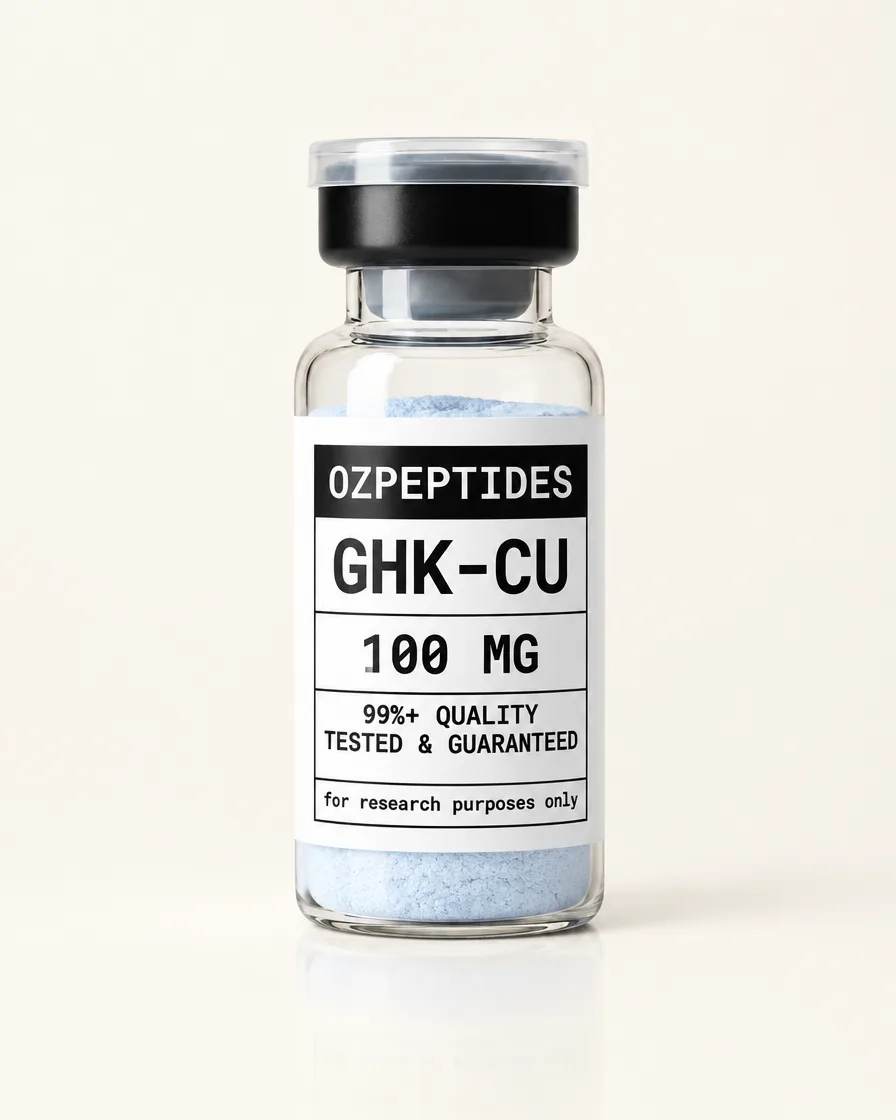
GHK-Cu is a copper complex, so heavy-metal testing needs to distinguish the copper that belongs there from contaminants that do not: lead, mercury, arsenic and cadmium are screened and must read zero. Correct copper loading is part of identity — under-complexed material is a common quality failure and looks fine to the eye, since the blue colour comes from the complex itself. Every batch is made and tested here in Australia, with the results recorded against the batch on your vial.
Where did GHK-Cu come from?
It was isolated from human plasma by Loren Pickart in 1973, and the observation that started the field was that concentrations fall substantially with age.
GHK is not a designed molecule. It occurs naturally in plasma, saliva and urine, and the original work found it in the context of studying why plasma from young donors behaved differently from plasma from older ones in liver tissue culture. Plasma GHK is reported at roughly 200 nanograms per millilitre around age twenty, falling to about eighty by age sixty. A naturally occurring peptide that declines with age is an obvious candidate for repair and skin research, and that is the observation five decades of subsequent work rests on.
Why does the copper matter?
Copper is a required cofactor for lysyl oxidase, the enzyme that crosslinks collagen and elastin, and for superoxide dismutase. GHK is the carrier that delivers it.
Free copper is toxic and is kept under tight control in the body, bound to carriers at essentially all times. What makes GHK useful is the balance of its binding: firm enough to transport copper safely, loose enough to exchange it with cellular carriers rather than holding it inert. That is not a trivial property to engineer and it is why the complex, rather than the peptide alone, is the object of the research. It also means under-complexed material is a real quality failure and an invisible one — the blue colour comes from the complex itself, so a vial short of copper can still look right.
What does the GHK-Cu research actually cover?
Collagen and glycosaminoglycan synthesis in fibroblast culture, wound-healing models, and more recently gene-expression profiling. Mostly topical or local, not systemic.
The older part of the literature is the steadier part: work through the 1980s and 90s on fibroblast behaviour, collagen production and wound models. The widely cited gene-expression paper, describing modulation of a large number of human genes toward a repair-associated profile, is more recent and more speculative — a profiling result is a description of what changed, not a demonstration that the change is beneficial. The important qualifier across all of it is route: the evidence concerns application to skin or to cells in culture, and extrapolating it to systemic administration is not supported by what was measured.
How does GHK-Cu differ from AHK-Cu?
By one methyl group — 14 daltons. GHK is a human plasma peptide with five decades of research; AHK-Cu is a designed analogue with a much smaller in-vitro literature.
The structural difference is trivial and the evidential difference is not. GHK-Cu carries the skin, wound-healing and gene-expression work; AHK-Cu has published in-vitro studies on dermal papilla cells and hair follicle elongation, which is why cosmetic interest in it centres on hair. No tidy mechanistic explanation exists for why one should favour follicles and the other dermis, since the copper chemistry is essentially shared, and treating that difference as established reads more into a small body of work than it supports. The 14-dalton gap is trivial for mass spectrometry and invisible to a purity figure.
How is GHK-Cu stored and reconstituted?
Lyophilised and cold for storage. Reconstituted with bacteriostatic water and kept refrigerated and dark, the practical window is weeks.
Copper complexes are light-sensitive, so a reconstituted vial belongs in the dark rather than on a bench — this matters more here than for most peptides in the catalogue. The blue colour is a rough but real visual check: a solution that has lost its tint has lost the complex. Bacteriostatic water rather than sterile water gives a multi-draw window, and the usual handling applies otherwise — diluent down the side of the vial, swirl rather than shake, since foaming indicates denatured peptide.
What strengths are stocked?
GHK-Cu is available in 50MG and 100MG vials. The larger vial is better value per milligram, and each strength page carries its own arithmetic.
Price per milligram is rarely linear across vial sizes, because synthesis, testing and fill costs are largely fixed per batch rather than per milligram. The reconstitution figures follow from the vial: 50MG in 2ML of bacteriostatic water gives 25MG/ML, while 100MG in the same volume gives 50MG/ML, so an identical draw delivers twice as much. That is the most common source of error when moving between strengths, which is why the reconstitution calculator is pre-filled per SKU rather than offering a generic worked example.
What should be checked in a GHK-Cu vial?
Identity by mass spectrometry, purity by HPLC, correct copper loading, and heavy metals screened separately from the copper that belongs there.
That last point is the one most suppliers gloss and it matters specifically for copper peptides: the copper in the complex is the active part, and the contaminants that must read zero are lead, mercury, arsenic and cadmium. A single combined "heavy metals" figure that does not distinguish the two is not telling you anything useful. Identity matters too, given AHK-Cu sits one methyl group away and is sold alongside it. We make GHK-Cu in Blacktown, NSW, at ≥99% HPLC purity with 0 ppm contaminant metals, measured separately from the complexed copper.
GHK-Cu vs AHK-Cu vs the GLOW Stack
Research-grade GHK-Cu, made in Australia.
Correct copper loading, confirmed identity, and heavy metals screened separately from the copper that belongs there. ≥99% HPLC purity, tested batch by batch.
Frequently asked
Yes. It was isolated from human plasma in 1973, and concentrations decline substantially with age — the observation the research field grew from.
It has lost the copper complex. The blue colour comes from the complex itself, which is why reconstituted vials belong in the dark.
By one methyl group, 14 daltons. GHK-Cu has five decades of research; AHK-Cu is a designed analogue with a small in-vitro literature.
Almost entirely topical or cell culture. Extrapolating it to systemic administration goes beyond what was measured.
A naturally occurring copper-binding tripeptide (glycine-histidine-lysine) found in human plasma, studied for collagen synthesis and wound repair.
Copper is a required cofactor for enzymes such as lysyl oxidase, which crosslinks collagen and elastin. GHK acts largely as a carrier for it.
It is the same compound, but a cosmetic formulation and a research-grade lyophilised vial are different products with different regulation.
GHK-Cu is available in 50MG and 100MG.
≥99% by HPLC, identity by mass spectrometry, and screening for lead, mercury, arsenic and cadmium — separate from the copper that belongs in the complex.
- Pickart L, Margolina A. Regenerative and protective actions of the GHK-Cu peptide in the light of the new gene data. Int J Mol Sci 2018;19:1987.
- Maquart FX, et al. Stimulation of collagen synthesis in fibroblast cultures by the tripeptide-copper complex glycyl-L-histidyl-L-lysine-Cu2+. FEBS Lett 1988;238:343–346.
This guide summarises published research for educational purposes. It is not medical advice. OzPeptides products are sold for research and laboratory use only, not for human consumption. 18+ only.