Key facts
What is the KLOW Stack?
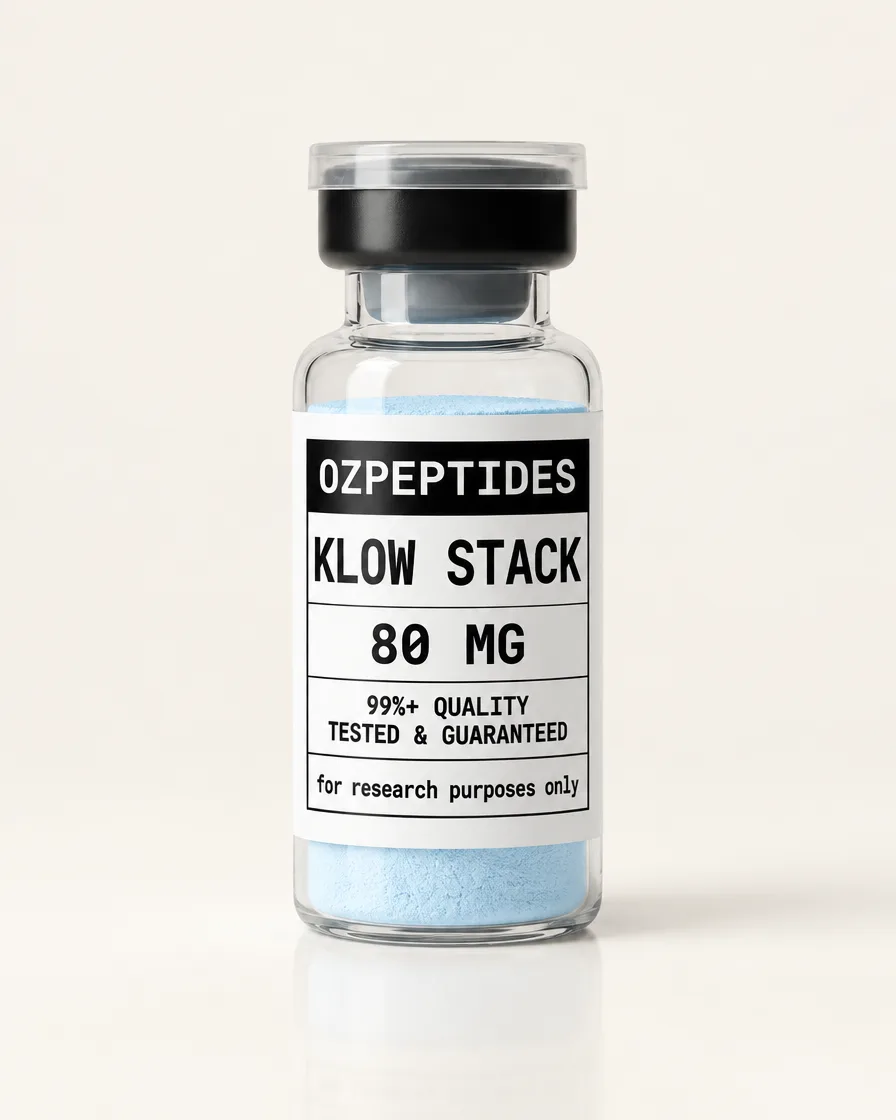
A single lyophilised vial containing four peptides, blended by weight in our lab.
The name is an acronym of its components: KPV, GHK-Cu, TB-500 (the "W" from Wolverine) and BPC-157. Each is available separately in our range; the blend exists because these four are so often studied together in skin and soft-tissue work that four reconstitutions becomes the limiting factor. It is prepared, lyophilised and tested as one finished product.
Why these four compounds?
Each is associated with a different part of the repair picture: structure, migration, vascular supply and inflammation.
GHK-Cu is the collagen and copper-cofactor component. TB-500 is associated with actin dynamics and cell migration, BPC-157 with angiogenesis and growth-factor signalling, and KPV with dampening NF-κB-driven inflammation. The reasoning is mechanistic rather than trial-based: there is no published study of this specific four-way blend, and the honest description is that it combines four separately studied compounds, not that the combination has been validated.
What is KLOW studied for?
Skin and soft-tissue repair research, drawing on the literature for each component.
Research relevant to KLOW is the research on its parts: GHK-Cu in collagen synthesis and wound models, BPC-157 and TB-500 in tendon, ligament and muscle models, KPV in colitis and skin inflammation models. Most of that is preclinical. Anyone evaluating the blend should read the four compound guides rather than treat the stack as a studied entity in its own right.
Is KLOW approved in Australia?
No. None of its components is an approved medicine here.
Nothing in the blend is registered in Australia, and both BPC-157 and TB-500 are on the WADA Prohibited List, which makes the blend prohibited in sport. OzPeptides supplies KLOW strictly for in-vitro and laboratory research, 18+, not for human consumption.
How is the blend quality verified?
Tested as a finished four-way blend, with each component confirmed.
A four-compound blend has four chances to get the ratio wrong, so it is prepared by weight and tested as the finished product rather than trusting the inputs. Identity of each peptide is confirmed by mass spectrometry, purity by HPLC, and the blend is screened for lead, mercury, arsenic and cadmium — with the copper in GHK-Cu accounted for separately. The results are recorded against the blend's batch number.
What does KPV add to the blend?
An anti-inflammatory component. KPV is the C-terminal tripeptide of alpha-MSH, reported to reduce NF-κB activation through an intracellular route.
The three peptides KLOW shares with GLOW address structure, cell migration and blood supply. KPV addresses inflammation, which is a separate arm of the same process and the reason the two blends exist as distinct products. Its reported mechanism is unusual: published work describes KPV entering cells through the PepT1 transporter and interfering with NF-κB, the transcription factor driving much of the inflammatory cytokine response — an intracellular route rather than a surface receptor. Notably it produces no pigmentation effect, because the part of alpha-MSH responsible for pigment is not in the fragment.
What are the other three components?
GHK-Cu for copper delivery and collagen crosslinking, TB-500 for actin binding and cell migration, BPC-157 for angiogenesis and growth-factor signalling.
Each addresses a different requirement. Copper is a cofactor for lysyl oxidase, the enzyme that crosslinks collagen and elastin into load-bearing structure, so GHK-Cu is the structural component and the one with the deepest literature. TB-500 reproduces the actin-binding region of thymosin beta-4, and cell migration depends on continuous actin assembly and disassembly — cells have to reach a site before anything is rebuilt there. BPC-157 is associated with blood supply and signalling. The four compound guides carry the actual evidence for each, including where it is thin.
Has KLOW been studied as a blend?
No. No published study covers this or any comparable four-peptide blend, and the evidence for a combination is not the sum of its parts.
The argument for combining these compounds is mechanistic: they are associated with different stages of the same process, so combining them is a reasonable hypothesis. A reasonable hypothesis is not a result. Interactions between compounds can be additive, redundant or antagonistic, and only a study of the combination can distinguish them. Anyone who describes a four-way blend as proven is describing something that does not exist, and the honest position is that KLOW offers convenience and a coherent rationale rather than evidence.
What does a blend actually change?
Handling. One reconstitution instead of four, one ratio identical in every vial, and one tested finished product rather than four separately certified inputs.
That is the real and defensible case for a blend. Weighing four powders by hand introduces error at every step, and four separate certificates describe four inputs that were never tested together. A finished blend prepared by weight in a laboratory and tested as a finished product carries a certificate describing what is actually in the vial. For anyone running these compounds in parallel, that reduction in handling error is a genuine benefit — it is just a different claim from a therapeutic one.
Is KLOW prohibited in sport?
Yes. BPC-157 is listed under WADA S0 and TB-500 under S2, both prohibited at all times, so the blend is.
A blend inherits the status of everything in it, and two of KLOW's four components are independently prohibited under the World Anti-Doping Code — one under the catch-all for substances with no human therapeutic approval, one under the growth-factor section. Both are prohibited in and out of competition and anti-doping laboratories have detection methods for both. There is no version of this blend that is permissible for an athlete subject to the Code.
How is a four-peptide blend reconstituted?
As one vial, with bacteriostatic water, directed down the side, swirled rather than shaken, refrigerated and kept dark afterwards.
Four peptides reconstituting as one is the practical advantage, and it also means a single handling error affects everything in the vial. Foaming indicates denatured peptide and in a blend there is no telling which component was damaged. The copper component makes light exposure worth avoiding — a solution that loses its blue tint has lost the GHK-Cu complex. Adding 2ML to an 80MG blend gives 40MG/ML of total peptide, with each component in the proportion the batch was made to.
How is a four-component blend tested?
As a finished product, not as inputs. Each peptide confirmed by mass spectrometry, purity by HPLC, and heavy metals screened with the complexed copper accounted for separately.
A blend has as many chances to go wrong as it has components, and testing the finished product is what makes the certificate describe the vial rather than the intention. The heavy-metal point matters specifically here: the copper carried by GHK-Cu belongs there, while lead, mercury, arsenic and cadmium must read zero, and a single combined figure that does not distinguish them is not a meaningful number. We prepare and test KLOW in Blacktown, NSW, at ≥99% HPLC purity with 0 ppm contaminant metals.
KLOW Stack, blended and tested in Australia.
Four peptides, one vial, one tested batch — prepared by weight here and tested as a finished blend, not as four hopeful inputs.
Frequently asked
GHK-Cu, BPC-157, TB-500 and KPV, at 80MG total peptide across the four components.
An anti-inflammatory component. It is the C-terminal tripeptide of alpha-MSH, reported to reduce NF-kB activation, with no pigmentation effect.
No. The published work covers each component separately, mostly in preclinical models.
Yes. BPC-157 is listed under WADA S0 and TB-500 under S2, both prohibited at all times.
GLOW is three compounds — GHK-Cu, BPC-157 and TB-500. KLOW adds KPV.
80MG total peptide.
- Pickart L, Margolina A. Regenerative and protective actions of the GHK-Cu peptide in the light of the new gene data. Int J Mol Sci 2018;19:1987.
- Dalmasso G, et al. PepT1-mediated tripeptide KPV uptake reduces intestinal inflammation. Gastroenterology 2008;134:166–178.
This guide summarises published research for educational purposes. It is not medical advice. OzPeptides products are sold for research and laboratory use only, not for human consumption. 18+ only.