Key facts
What is AHK-Cu?
AHK-Cu is a synthetic copper tripeptide that differs from the naturally occurring GHK-Cu by a single amino acid.
Swapping glycine for alanine at the first position changes the peptide's size and hydrophobicity slightly while keeping the copper-binding histidine and lysine intact. Unlike GHK, AHK is not a naturally occurring plasma peptide — it is a designed analogue, and its research history is correspondingly shorter and narrower.
How does AHK-Cu work?
Like GHK-Cu, it binds and delivers copper; published work reports effects on dermal papilla cells in hair follicle models.
The copper-carrier role is shared with GHK-Cu, and copper-dependent enzymes are the same. What differs is where the research has looked: studies on AHK-Cu report increased proliferation of dermal papilla cells and effects on hair follicle growth markers in culture, which is why cosmetic interest has centred on hair rather than skin. The mechanistic detail behind that preference is not well resolved.
What is AHK-Cu studied for?
Hair follicle research, and cosmetic formulation for scalp products.
Published work includes in-vitro studies on dermal papilla cell proliferation and follicle elongation in culture. The evidence base is much smaller than GHK-Cu's and mostly in-vitro, so it is better described as a compound of active interest than a well-characterised one. Anyone comparing the two should expect far more literature on GHK-Cu.
Is AHK-Cu approved in Australia?
No. It is not a registered medicine and is supplied for research only.
AHK-Cu is not registered in Australia. It appears in some cosmetic formulations, which is a separate regulatory pathway that does not apply to a research-grade vial. OzPeptides supplies it for in-vitro and laboratory research, 18+, not for human consumption.
How is research-grade AHK-Cu quality verified?
HPLC purity, mass-spec identity, heavy-metal screening, and correct copper complexation.
AHK and GHK differ by one residue and by 14 daltons — a difference mass spectrometry resolves easily and a purity assay alone does not. Given the two are sold side by side, identity confirmation is the test that keeps them straight. Every batch is made and tested in our Australian lab, with contaminant metals screened separately from the complexed copper.
What is AHK-Cu?
A designed copper-binding tripeptide — alanine, histidine, lysine — complexed with copper. It differs from GHK-Cu by a single methyl group.
AHK-Cu is not a human plasma peptide. It was designed as an analogue of GHK, swapping glycine for alanine at the first position, and that single change is the whole structural difference between the two: 14 daltons. It binds copper through the same histidine and lysine residues, produces the same characteristic blue solution, and shares essentially the same copper chemistry. What it does not share is GHK's research record, and a page that treats the two as interchangeable on the strength of their similarity is skipping the part that matters.
Why is AHK-Cu associated with hair research?
Published in-vitro work reports increased proliferation of dermal papilla cells and effects on hair follicle elongation in culture.
Dermal papilla cells sit at the base of the follicle and govern the hair growth cycle, so a compound reported to affect their proliferation is a reasonable subject for follicle research. That is where the cosmetic interest comes from. What is missing is a mechanistic reason for the preference: the copper chemistry is shared with GHK-Cu, so there is no tidy explanation for why one analogue should favour follicles and the other dermis. The distinction is an observation from a small in-vitro literature, not an established difference in mechanism.
How much evidence is there for AHK-Cu?
Considerably less than for GHK-Cu. The published record is a small number of in-vitro studies, with no clinical programme and no human data of substance.
Being honest about this is more useful than the alternative. AHK-Cu is a plausible compound with a coherent rationale and a thin literature — which describes a great many research peptides and is not a criticism, only a description. Anyone choosing between the two copper peptides on the strength of evidence should choose GHK-Cu, which has five decades behind it. Anyone interested specifically in the follicle work should know it is in-vitro, small, and not independently replicated at scale.
How does the copper chemistry work?
The histidine and lysine residues bind copper(II), and the complex is what carries the activity. Copper is a cofactor for lysyl oxidase and superoxide dismutase.
Lysyl oxidase crosslinks collagen and elastin into load-bearing structure, and it cannot function without copper; superoxide dismutase is one of the cell's antioxidant enzymes and has the same requirement. Free copper is toxic and tightly controlled in the body, so a carrier that binds it firmly enough to transport and loosely enough to release is genuinely useful. Under-complexed material is the common quality failure in both copper peptides, and it is invisible — the blue colour comes from the complex, so a vial short of copper can still look right.
How is AHK-Cu stored and reconstituted?
Lyophilised and cold for storage; bacteriostatic water for reconstitution, refrigerated and kept dark, with a practical window of weeks.
Copper complexes are light-sensitive, which makes dark storage of a reconstituted vial more important here than for most peptides. The colour is a rough visual check — a solution that has lost its blue has lost the complex. Otherwise the handling is standard: bacteriostatic water rather than sterile for a multi-draw window, diluent directed down the side of the vial, swirl rather than shake, and refrigerate once mixed.
Is AHK-Cu prohibited in sport?
It has no approval for human therapeutic use anywhere, which places it under the WADA S0 catch-all.
S0 covers pharmacological substances with no current approval by any governmental regulatory health authority for human therapeutic use and not addressed elsewhere on the Prohibited List. AHK-Cu has no such approval, so athletes subject to anti-doping rules should treat it as prohibited at all times. The absence of a specific named entry is not an exemption.
What should be checked in an AHK-Cu vial?
Identity by mass spectrometry above all, since GHK-Cu sits 14 daltons away and is sold alongside it, plus purity, copper loading and separated heavy metals.
An HPLC trace can read 99% on the wrong peptide — purity measures the fraction of what is present that is a single species, not which species it is. With two similarly named copper peptides at similar prices on the same shelf, identity confirmation is the check that distinguishes a supplier who tests from one who relabels. Heavy-metal screening also needs the copper accounted for separately: lead, mercury, arsenic and cadmium must read zero, and a combined figure hides them. We make AHK-Cu in Blacktown, NSW, at ≥99% HPLC purity with 0 ppm contaminant metals.
What strengths are stocked, and how the arithmetic works
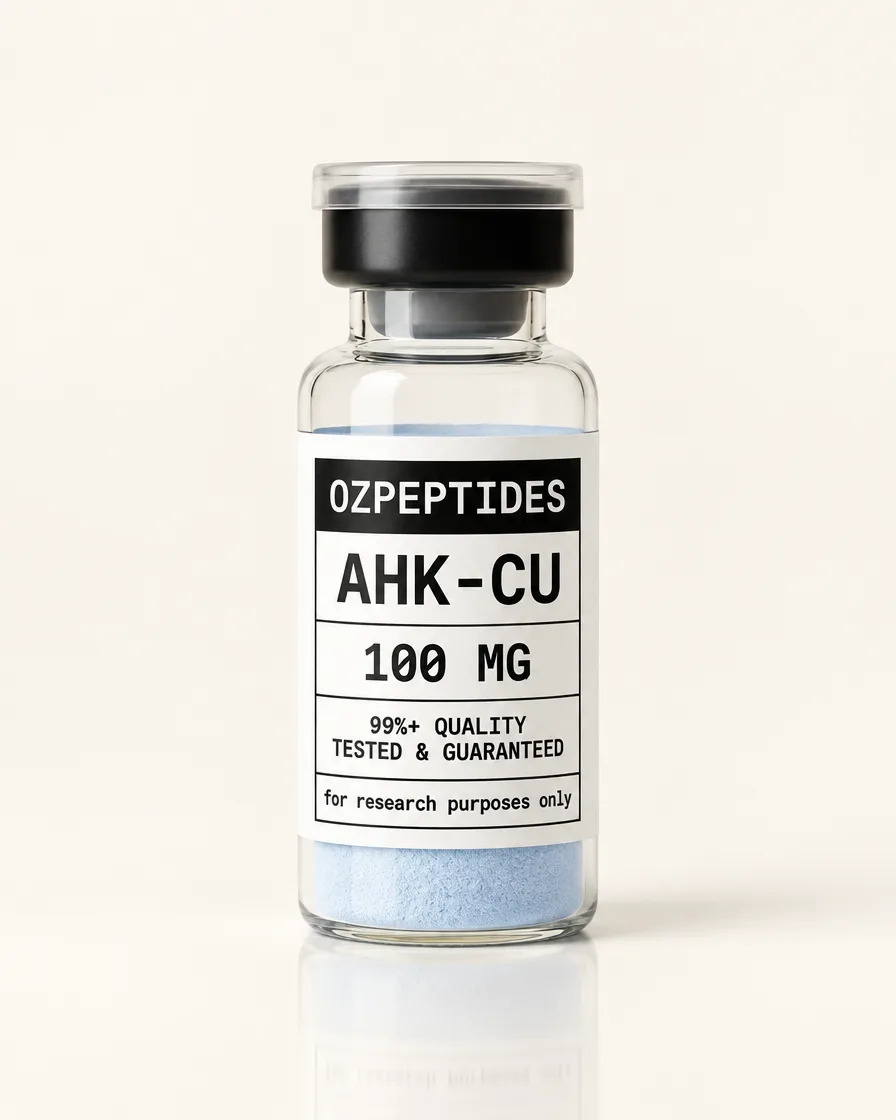
AHK-Cu is stocked in one strength, a 100MG vial. There is no 50MG, and the product page carries the vial's own numbers.
With a single strength, the arithmetic that matters is the volume of water, not the size of the vial. 100MG in 2ML of bacteriostatic water gives 50MG/ML; the same vial in 3ML gives about 33.3MG/ML, so an identical draw on an insulin syringe delivers a third less. Getting that volume wrong is the most common arithmetic error with any peptide, which is why the reconstitution calculator is pre-filled per SKU rather than offering one generic worked example. Copper peptides are also among the compounds most often ordered pre-mixed, since the blue solution gives a rough visual confirmation that the complex survived; mixed in vial and pen cartridge cost nothing extra (or $5 more per vial while a sale is running).
Research-grade AHK-Cu, made in Australia.
One amino acid separates this from GHK-Cu, so we confirm which one you have: mass-spec identity, ≥99% HPLC purity, 0 ppm contaminant metals.
Frequently asked
100MG only. There is no 50MG; the single strength is sold as a vial, pre-mixed or as a pen cartridge, with mixing at no extra cost (or $5 more per vial while a sale is running).
No. It is a designed analogue of GHK, differing by one methyl group, with no plasma origin of its own.
Published in-vitro work reports effects on dermal papilla cell proliferation and follicle elongation. The body of evidence is small.
No. Purity can read 99% on the wrong peptide. The 14-dalton difference is resolved by mass spectrometry.
GHK-Cu, by a wide margin — five decades of skin, wound-healing and gene-expression work against a handful of in-vitro studies.
A synthetic copper-binding tripeptide (alanine-histidine-lysine with copper), closely related to GHK-Cu.
One amino acid: alanine replaces glycine at the first position. GHK-Cu occurs naturally in human plasma; AHK-Cu is a designed analogue.
- Pyo HK, et al. The effect of tripeptide-copper complex on human hair growth in vitro. Arch Pharm Res 2007;30:834–839.
- Pickart L, Margolina A. Regenerative and protective actions of the GHK-Cu peptide in the light of the new gene data. Int J Mol Sci 2018;19:1987.
This guide summarises published research for educational purposes. It is not medical advice. OzPeptides products are sold for research and laboratory use only, not for human consumption. 18+ only.