Key facts
What is AOD-9604?
AOD-9604 is the C-terminal fragment of human growth hormone, synthesised on its own rather than as part of the full 191-residue hormone.
The premise behind it is a genuine piece of Australian science: research at Monash University in the 1990s indicated that growth hormone's effects on fat metabolism and its effects on growth are carried by different parts of the molecule. AOD-9604 isolates the first part. Metabolic Pharmaceuticals in Melbourne took it into clinical development, and while it did not become a registered medicine, it remains one of the more thoroughly characterised fragments in this space.
How does AOD-9604 work?
Published work associates it with lipolytic activity that does not depend on the growth hormone receptor in the way full-length hGH does.
Research has reported effects on fat metabolism in cell and animal models without the IGF-1 elevation and insulin-resistance signal that characterises full-length growth hormone. That separation is the entire research rationale. Human trial results were more modest than the preclinical work suggested — a pattern worth being straight about, since it is the reason the compound did not progress to registration.
What is AOD-9604 studied for?
Obesity and fat-metabolism research, and later cartilage and osteoarthritis models.
Phase 2 trials in obesity were conducted in the 2000s and did not meet the bar for development to continue. Research since has looked at other directions including cartilage repair models. In the United States, AOD-9604 obtained self-affirmed GRAS status for use as a food ingredient, which is a food-law classification and not a therapeutic approval — a distinction sometimes misrepresented in marketing.
Is AOD-9604 approved in Australia?
No — and it is explicitly prohibited in sport.
AOD-9604 is not registered in Australia. It is also named on the WADA Prohibited List under S2 (growth hormone fragments), so it is banned in competitive sport at all times, in and out of competition. Anyone subject to anti-doping rules should treat that as decisive. OzPeptides supplies it for in-vitro and laboratory research only, 18+, not for human consumption.
How is research-grade AOD-9604 quality verified?
HPLC purity, mass-spec identity and heavy-metal screening on every batch.
A fragment peptide has a specific risk: the product that is nearly right. A sequence one residue short will look similar on a basic assay and different on mass spectrometry, which is why identity confirmation is not optional here. Every OzPeptides batch is tested in our Australian lab before release at ≥99% HPLC purity and 0 ppm heavy metals, with those results recorded against the batch number on your vial.
Where did AOD-9604 come from?
Monash University in Melbourne. It is a fragment of human growth hormone — residues 176-191 — developed by Professor Frank Ng's group and licensed to Metabolic Pharmaceuticals.
AOD-9604 is a genuinely Australian piece of peptide science, and one of the few compounds in this catalogue with a local development history. The premise was that growth hormone's effects on fat metabolism sit in a specific region of the molecule, separable from the growth-promoting effects that come from receptor binding elsewhere. Isolating that fragment was meant to give the metabolic activity without the growth hormone activity — an elegant idea that the clinical results did not support.
What happened in the AOD-9604 trials?
It reached phase 2b in obesity and did not separate from placebo on the primary endpoint. Development for that indication stopped.
This is the part of the story most pages selling AOD-9604 leave out, and stating it plainly is more useful than any claim about the compound. A phase 2b trial that fails its primary endpoint is a real result, not an absence of evidence. Later work explored it for osteoarthritis and cartilage repair on a different rationale, and it has been granted GRAS status as a food ingredient in the United States, which is a food-safety determination rather than an efficacy finding.
Does AOD-9604 act like growth hormone?
It is not reported to. The fragment lacks the regions responsible for growth hormone receptor binding, so it does not raise IGF-1.
That absence was the entire design goal: growth hormone's anabolic and glycaemic effects come from receptor binding that the 176-191 fragment does not do. Published work reports no effect on IGF-1 levels and no growth-promoting activity, which is a point in the compound's favour on safety and a point against any claim that it behaves like growth hormone. It does mean AOD-9604 sits outside the secretagogue category entirely.
Is AOD-9604 prohibited in sport?
It has appeared in Australian anti-doping proceedings and has no approval for human therapeutic use, so it is treated as prohibited.
AOD-9604 has a particular history in Australian sport, having featured in the 2013 Australian Crime Commission report and the supplements investigations that followed. Whether it is best classified under S0 or as a growth-factor-related substance has been argued; the practical answer for any athlete is that it is not permitted, and the Australian precedent for that is unusually well documented.
How is AOD-9604 stored and reconstituted?
Lyophilised and cold for storage; bacteriostatic water for reconstitution, refrigerated, with a window of weeks.
A 16-residue fragment dissolves readily. The standard handling applies: bacteriostatic water rather than sterile so the vial can be drawn from over weeks, diluent down the side, swirl rather than shake, refrigerate and keep out of light once mixed. The reconstitution calculator carries the arithmetic for the strengths we stock.
What should be checked in an AOD-9604 vial?
Identity and purity. The sequence is short and simple, so a genuine batch should test very clean.
The compound has also been sold in amidated and non-amidated forms that differ in mass, which is the specific thing mass spectrometry settles and a purity figure does not. We make AOD-9604 in Blacktown, NSW, at ≥99% HPLC purity with 0 ppm heavy metals, with the vial batch number linked to its certificate.
What GRAS status actually means
Generally Recognised As Safe is a United States food-ingredient determination. It says a substance is acceptable in food, not that it does anything.
AOD-9604 received GRAS status for use as a food ingredient in the US, and that fact is used widely in marketing as though it were a regulatory endorsement of the compound. It is not. GRAS is a safety determination made for a specific use at a specific level, with no assessment of efficacy at all — a substance can be entirely safe and entirely inert. It also has no standing in Australia, where AOD-9604 has never been assessed or registered.
The later osteoarthritis research
After the obesity programme stopped, AOD-9604 was explored for cartilage and joint applications on a different rationale, with preclinical and early clinical work.
This second life is worth knowing because it is the origin of most current interest in the compound, and because the rationale is unrelated to the fat-metabolism one it was designed for. Work has looked at cartilage repair in animal models and at intra-articular administration. It has not produced a registered product, and the evidence is early — which puts AOD-9604 in the position of having a failed trial behind it for one indication and thin preclinical data for another. Both facts belong in any honest summary of it.
Research-grade AOD-9604, made in Australia.
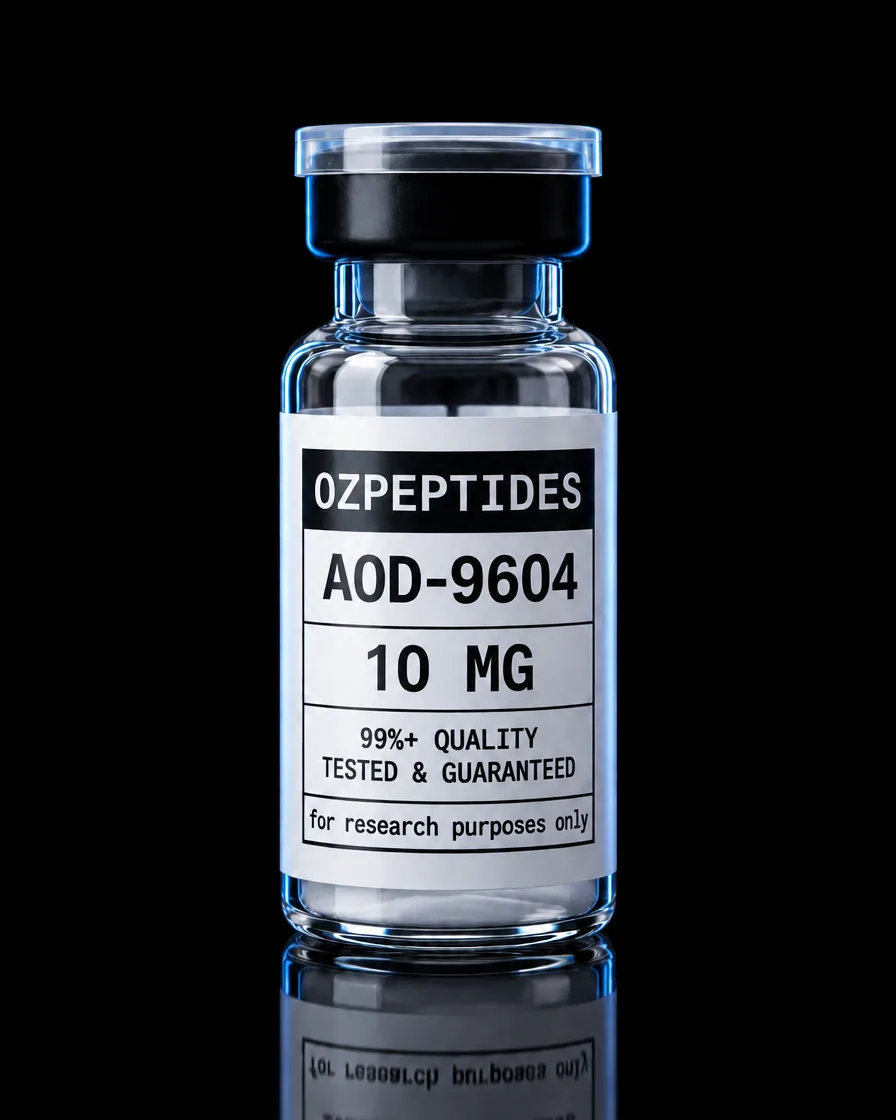
A compound first developed here, made here again: ≥99% HPLC purity, mass-spec identity, 0 ppm heavy metals, tested batch by batch.
Frequently asked
No. GRAS is a United States food-ingredient safety determination with no efficacy assessment, and no standing in Australia.
Work after the obesity programme stopped, exploring cartilage and joint applications on a different rationale. It is early and has produced no registered product.
Professor Frank Ng's group at Monash University in Melbourne, licensed to Metabolic Pharmaceuticals.
It reached phase 2b in obesity and did not separate from placebo on the primary endpoint. Development for that indication stopped.
Published work reports it does not. The fragment lacks the regions responsible for growth hormone receptor binding.
It has no approval for human therapeutic use and features in Australian anti-doping precedent. Treat it as prohibited.
A 16-amino-acid fragment of human growth hormone (residues 176–191), developed in Melbourne to study fat metabolism separately from growth effects.
No. It is a small fragment of the molecule and does not carry the growth-promoting activity of full-length hGH.
No. It is not registered in Australia and is supplied for research use only.
AOD-9604 is available in 10MG.
- Heffernan M, et al. The effects of human GH and its lipolytic fragment (AOD9604) on lipid metabolism following chronic treatment in obese mice and β3-AR knock-out mice. Endocrinology 2001;142:5182–5189.
- World Anti-Doping Agency. Prohibited List — Section S2, Peptide Hormones, Growth Factors, Related Substances and Mimetics.
This guide summarises published research for educational purposes. It is not medical advice. OzPeptides products are sold for research and laboratory use only, not for human consumption. 18+ only.