Key facts
What is in the blend?
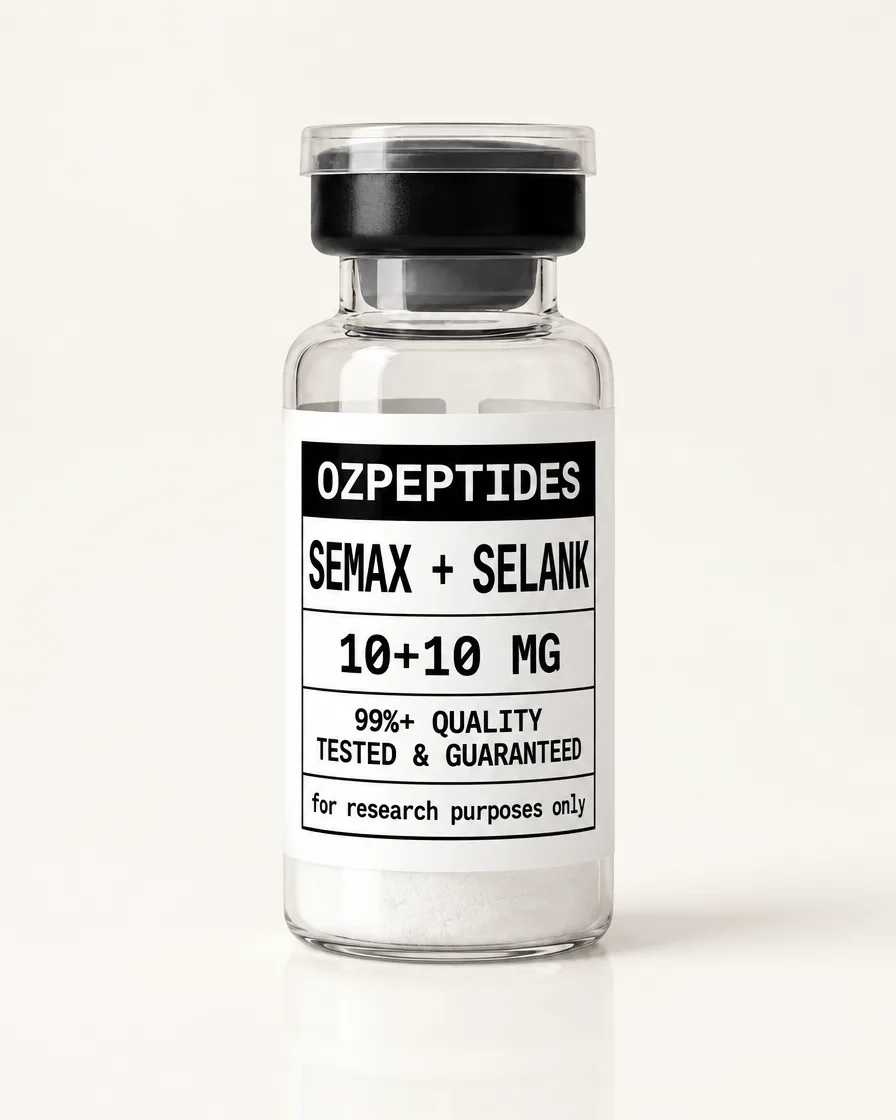
Equal amounts of Semax and Selank, blended by weight and lyophilised together.
The label reads 10+10MG because with a blend the per-compound amount is the useful figure. Both peptides come from the same Russian design programme and share the Pro-Gly-Pro stabilising tail, so they behave similarly in handling and storage — which is part of why they blend sensibly in the first place.
Why are they studied together?
Their reported effects address different things: Semax the cognitive and neurotrophic side, Selank the anxiety and GABAergic side.
The pairing is a convenience and a complementarity argument, not a validated combination. There is no published trial of the blend as such, and both compounds report effects on BDNF, so it would be wrong to assume the two are entirely independent. The honest description is that each has its own literature and this vial holds both.
What is the blend studied for?
Cognition and anxiety research, drawing on the separate literature for each peptide.
Read the Semax and Selank guides for what the evidence actually covers: Russian clinical work in stroke, cognition and anxiety, plus rodent studies on BDNF and monoamine signalling. As with all our blends, the practical value here is a single reconstitution and a single tested batch.
Is the blend approved in Australia?
No. Neither component is registered here.
Both are registered medicines in Russia and neither is registered in Australia. OzPeptides supplies the blend for in-vitro and laboratory research only, 18+, not for human consumption.
How is the blend quality verified?
Both peptides confirmed by mass spectrometry, purity by HPLC, heavy metals screened.
Semax and Selank are both seven residues and both end in Pro-Gly-Pro, which makes them a pair worth confirming individually rather than assuming from a label. We blend by weight in our own lab and test the finished product at ≥99% HPLC purity with 0 ppm heavy metals.
Why are Semax and Selank combined?
Because their research emphases are complementary — cognition and neuroprotection for one, anxiety for the other — and they share a design tradition and a stabilising motif.
Both are built the same way: an active fragment of a larger molecule with a Pro-Gly-Pro tail bolted on for stability. Semax's fragment comes from ACTH, Selank's from tuftsin. Combining them pairs two different reported mechanisms in one vial, which is a coherent rationale for anyone studying both. It is a rationale rather than a result, and there is no published study of the combination — the evidence, such as it is, covers each compound separately.
What is in the blend?
Semax and Selank in equal parts, at 10+10MG. We label it by component because with a combination the per-compound figure is the one that means something.
A blend quoted only as a total leaves out what any calculation needs, and makes price-per-milligram comparisons against single compounds meaningless, because the milligrams are not of the same thing. Labelling by component also makes the ratio checkable against the certificate. Ours is prepared by weight in our own lab and the finished blend is tested, so the certified ratio is the ratio in the vial rather than the ratio intended.
Why is the Russian literature treated cautiously?
Because much of it predates modern trial reporting standards and appears in journals that are not indexed or replicated internationally.
This is not a dismissal of Russian science, and it is worth separating the two things it could mean. The concern is methodological and practical: trials that cannot be checked — because the reporting is thin, the journal is not indexed, or no unaffiliated group has repeated the work — carry less evidential weight regardless of where they were run. The same standard applies to any literature. What it means in practice is that volume of publication is not a substitute for replication, and a compound with fifty papers from one tradition and none from outside it is not as well established as the paper count suggests.
Why the intranasal route?
Because the olfactory route can reach the central nervous system without crossing the blood-brain barrier through circulation, which matters for peptides too large to cross it easily.
Both Semax and Selank were developed as intranasal formulations and most of the published clinical work used that route. The rationale is real rather than marketing: olfactory and trigeminal pathways offer direct access to the brain, bypassing systemic circulation and hepatic clearance. Research vials are supplied lyophilised, so the route in any given study is a laboratory choice rather than something the product dictates — but published dose figures generally refer to intranasal administration, and reading them as though they applied to another route is a straightforward way to misinterpret the literature.
Is there research on the blend?
No. Both compounds have their own literatures, largely Russian and largely unreplicated internationally, and neither covers the combination.
The evidence for a combination is not the sum of the evidence for its parts, because interactions can be additive, redundant or antagonistic and only a study of the combination distinguishes them. That caveat matters more here than usual, given both component literatures are already thin by international standards. The honest position is that this blend offers convenience and a coherent rationale, and that claims beyond that are not supported.
Is the blend prohibited in sport?
Neither component is currently named on the WADA Prohibited List, but both lack approval outside Russia, which arguably engages S0.
A blend inherits the status of everything in it, and here both components sit in the same ambiguous position. An arguable classification is a bad position for an athlete to be in, and research-grade material carries no therapeutic use exemption pathway in any case. Check the current Prohibited List directly rather than relying on a supplier summary, including this one.
Which variants are in the blend?
The plain forms of both. Semax and Selank are each sold in modified variants that differ in mass, so a blend has two identity questions rather than one.
This is the specific quality problem with a blend of two compounds that each come in several forms: there are more ways for the vial to contain something other than what the label says, and no purity figure catches any of them. Both components are confirmed by mass spectrometry in the finished product as sold, which is the only way the ratio and the identities can both be verified.
How is the blend reconstituted and stored?
As one vial. Bacteriostatic water directed down the side, swirled not shaken, refrigerated and kept dark, with a practical window of weeks.
Single-vial handling is the practical advantage of a blend, and the corresponding risk is that one error affects both peptides with no way to tell which was damaged — foaming indicates denatured peptide but not which component. Adding 2ML to a 20MG blend gives 10MG/ML of total peptide, with each component at 5MG/ML. We prepare and test the blend in Blacktown, NSW, at ≥99% HPLC purity with 0 ppm heavy metals.
Semax + Selank, blended and tested in Australia.
Two seven-residue peptides that look alike on a label, confirmed separately by mass spec and blended by weight in our own lab.
Frequently asked
Both peptides in equal parts, at 10+10MG. It is labelled by component because the per-compound figure is what any calculation needs.
No. Each compound has its own literature, largely Russian and largely unreplicated; neither covers the combination.
Their research emphases are complementary — cognition and neuroprotection for Semax, anxiety for Selank — and they share a design tradition.
Yes. Each component comes in several variants, so there are more ways for the vial to differ from the label, and no purity figure catches them.
They share a design lineage and the same stabilising tail, so they handle and store alike.
No. Supplied for research and laboratory use only.
10+10MG — 10MG of each.
- Dolotov OV, et al. Semax regulates expression of BDNF in rat hippocampus. J Neurochem 2006;97:82–86.
- Zozulya AA, et al. The efficacy of Selank in anxious-asthenic disorders. Zh Nevrol Psikhiatr 2008;108:38–48.
This guide summarises published research for educational purposes. It is not medical advice. OzPeptides products are sold for research and laboratory use only, not for human consumption. 18+ only.