Key facts
What is Adamax?
Adamax is a modified peptide in the Semax lineage, sold for nootropic research, with chemical modification intended to improve stability.
The compounds in this family are all built on the same idea: take a short behaviourally active fragment of ACTH, then modify it so it survives long enough to study. Adamax is described in supplier and community literature as one such modification. Unlike Semax, which has a substantial if geographically narrow research record, Adamax has next to no independent published characterisation — and pretending otherwise would be the easy thing to do here.
How is Adamax proposed to work?
By the same mechanisms claimed for the Semax family: effects on BDNF and monoamine signalling. That is inference from relatives, not evidence for this compound.
Because the family's reported mechanism centres on neurotrophic factor expression, that is what gets attributed to Adamax. It is worth being explicit about the logic: an assumption based on structural similarity is a hypothesis to test, not a finding. Anyone studying this compound is closer to characterising it than to applying known pharmacology.
What is Adamax studied for?
Nootropic and neurotrophic research, with almost no published trial data to point to.
We can point to the Semax literature as context and to nothing substantial on Adamax itself. That makes it a compound for exploratory laboratory work rather than one with an established profile. If you are looking for a peptide in this space with an actual evidence base, Semax and Selank are the better documented choices, and we would rather say that than sell on implication.
Is Adamax approved in Australia?
No. It is not registered anywhere as a medicine.
Adamax is not registered in Australia and no approval elsewhere that we are aware of. It falls within the WADA S0 catch-all for athletes. OzPeptides supplies it for in-vitro and laboratory research only, 18+, not for human consumption.
How is research-grade Adamax quality verified?
HPLC purity and mass-spec identity per batch, heavy metals screened.
With a thinly documented compound, identity confirmation carries more weight than usual: there is no large body of independent characterisation to compare a batch against, so the testing behind the batch is most of what you have. We make and test every batch in our Australian lab at ≥99% HPLC purity with 0 ppm heavy metals, with the mass confirming the molecule.
What is Adamax?
An analogue in the Semax family — an ACTH-derived fragment with a modified stabilising tail, developed in the same Russian research tradition.
Adamax belongs to the group of short peptides built on the same principle as Semax and Selank: take an active fragment of a larger molecule, attach a proline-rich terminus that resists degradation, and you have something stable enough to study. The modifications distinguishing Adamax are at the tail rather than in the active fragment, which is the usual place this tradition makes changes. That shared design lineage is the most reliable thing that can be said about it.
How much is known about Adamax?
Very little by international standards. It is among the least documented compounds in this catalogue, with essentially no independent published literature.
This needs saying plainly rather than being dressed up. Where Semax has a substantial if unreplicated Russian literature, Adamax has considerably less even than that, and next to nothing in internationally indexed journals. Anyone considering it should understand they are working with a compound whose properties are largely inferred from its family resemblance rather than established by study of the compound itself. That is a legitimate position for exploratory research and an untenable one for any claim about effects.
How does Adamax relate to Semax?
It is a structural relative from the same design tradition, with a modified terminus. The two are not interchangeable and the research bases are not comparable.
Structural similarity is a weak basis for transferring findings, and the peptide literature is full of examples where small modifications changed behaviour substantially — MT-1 and MT-2 differ by cyclisation and have different receptor profiles; GHK-Cu and AHK-Cu differ by a methyl group and have different research records. Reading Semax data onto Adamax because they are relatives is exactly the error those examples warn against.
Is Adamax prohibited in sport?
It has no approval for human therapeutic use anywhere, which places it under the WADA S0 catch-all.
S0 covers substances with no current approval by any governmental regulatory health authority for human therapeutic use and not addressed elsewhere on the list. Adamax has no approval in any jurisdiction, including Russia. Athletes subject to anti-doping rules should treat it as prohibited at all times; the absence of a named listing is not an exemption, and obscurity is not a defence.
What is Adamax's status in Australia?
Not registered in Australia. Supplied for in-vitro and laboratory research only, to buyers aged 18 and over.
Adamax has never been assessed for use in Australia, and no approved product containing it exists anywhere. For a compound this thinly documented, that regulatory silence simply reflects the state of the research: there is nothing for a regulator to have assessed. It is supplied here as a laboratory reagent and nothing more.
Why does identity confirmation matter especially here?
Because a poorly documented compound is a poorly checkable one. With little published characterisation, the certificate is the only description of what is in the vial.
For a well-known peptide, a buyer has reference data, published masses and community familiarity to check against. For an obscure analogue none of that exists, which makes the supplier's own analytical work the entire basis for knowing what the material is. That raises rather than lowers the standard: mass spectrometry to confirm the molecule, HPLC for purity, and a certificate that resolves to the batch number on the vial.
How is Adamax stored and reconstituted?
Lyophilised and cold for storage; bacteriostatic water for reconstitution, refrigerated, with a practical window of weeks.
Bacteriostatic water rather than sterile water is what makes a multi-draw vial possible, since the benzyl alcohol in it inhibits bacterial growth where sterile water offers no protection. Direct the diluent down the side of the vial and swirl rather than shake: foaming is a reliable sign of denatured peptide. Keep the reconstituted vial refrigerated and out of light. The reconstitution calculator is pre-filled per SKU, so the concentration and the units on a standard insulin syringe come from the vial in hand rather than a generic worked example.
What should be checked in an Adamax vial?
Identity by mass spectrometry above all, then purity by HPLC and fill weight.
Short peptides in this family are inexpensive to synthesise well, so a genuine batch should test very clean, and a mediocre purity figure is a statement about the supplier. The greater risk with an obscure compound is substitution — a related peptide from the same family supplied under the wrong name, which no purity assay detects. We make Adamax in Blacktown, NSW, at ≥99% HPLC purity with 0 ppm heavy metals, with identity confirmed per batch.
Research-grade Adamax, made in Australia.
Thinly documented compounds are exactly where real testing matters: mass-spec identity, ≥99% HPLC purity, 0 ppm heavy metals, made here.
Frequently asked
Barely. It is among the least documented compounds in this catalogue, with essentially no independent published literature.
No. Structural similarity is a weak basis for transferring findings, and small modifications routinely change peptide behaviour.
No, including in Russia. It is not registered in Australia and is supplied for laboratory research only.
Because there is no published reference data to check against, so the supplier's own analytical work is the only description of the material.
A nootropic research peptide in the Semax family — an ACTH-fragment derivative with stability modifications.
It shares the ACTH-fragment lineage and the design idea, but not Semax's research record.
If you want a documented compound in this space, Semax and Selank have far more literature behind them.
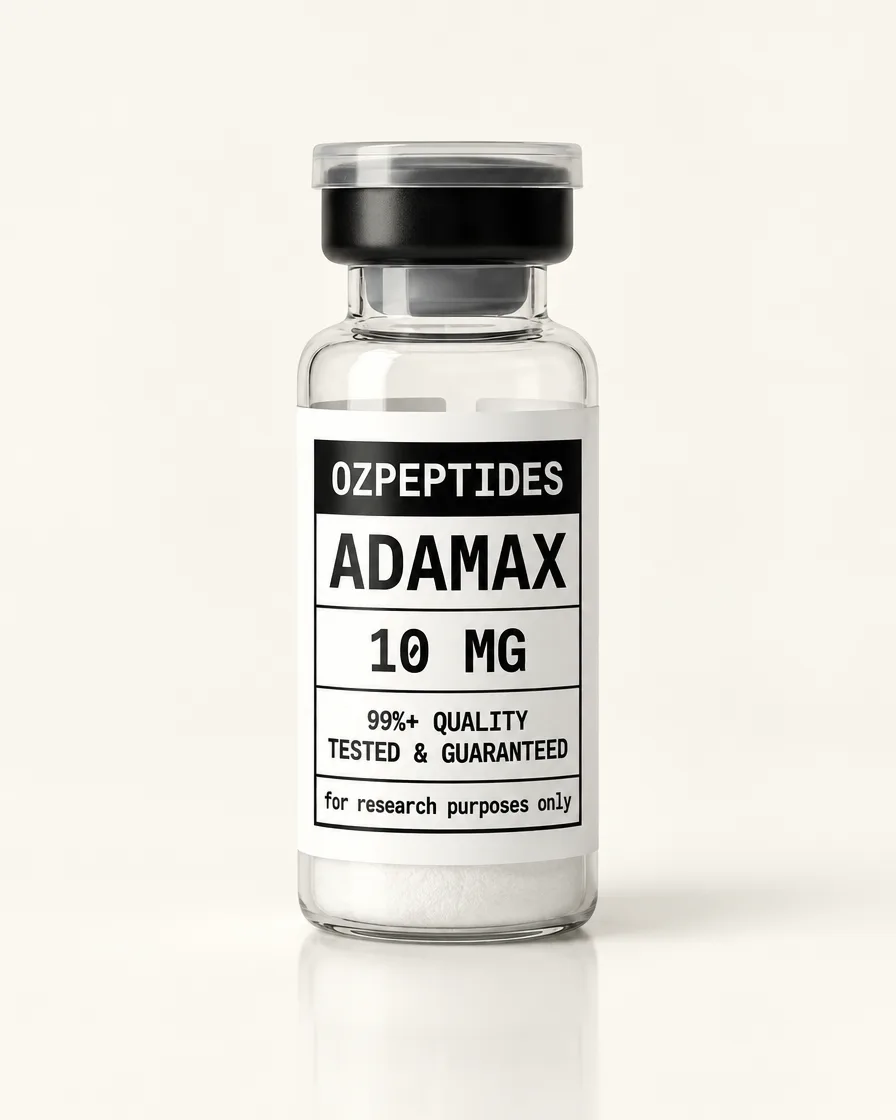
Adamax is available in 10MG.
- Dolotov OV, et al. Semax, an analogue of ACTH(4-7), regulates expression of BDNF in rat hippocampus — background for the compound family. J Neurochem 2006;97:82–86.
This guide summarises published research for educational purposes. It is not medical advice. OzPeptides products are sold for research and laboratory use only, not for human consumption. 18+ only.