Key facts
What is semaglutide?
Semaglutide is a synthetic analogue of the gut hormone GLP-1, modified so it survives in the body long enough for weekly rather than daily use.
Native GLP-1 is broken down within minutes by the enzyme DPP-4. Semaglutide changes that with a substitution at position 8 that blocks the enzyme, and a fatty-acid chain that binds albumin and slows clearance — the reason its half-life is around a week rather than a couple of minutes. It is the most extensively studied compound in this class and the one newer agonists are measured against, which is exactly why it turns up so often as a reference compound in laboratory work.
How does semaglutide work?
It activates a single receptor, GLP-1, with high selectivity.
GLP-1 receptor activation is associated with glucose-dependent insulin release, slowed gastric emptying and satiety signalling in the hypothalamus. Because semaglutide acts on one receptor rather than several, it is the cleanest tool in the incretin family for isolating GLP-1 effects — which is its research value. When a study wants to know whether an effect comes from GLP-1 specifically rather than combined incretin signalling, semaglutide is usually the comparator.
What is semaglutide studied for?
Type 2 diabetes and obesity research, and increasingly cardiovascular and renal endpoints.
The SUSTAIN and STEP trial programmes established its metabolic profile, and SELECT (2023) reported cardiovascular outcomes in people with overweight or obesity and established cardiovascular disease. Laboratory research continues into GLP-1 receptor distribution beyond the pancreas and gut, including work on neuroinflammation and appetite circuitry. There is far more published data on semaglutide than on any other compound in our metabolic range.
Is semaglutide approved in Australia?
Semaglutide is approved as a prescription medicine — but research-grade semaglutide is not a medicine and is not supplied as one.
Ozempic and Wegovy are registered in Australia and are available only on prescription from a doctor. Research-grade semaglutide is a laboratory reagent: it is not registered, not dispensed against a prescription, and not for human consumption. Those are two different products with two different purposes, and the distinction matters. If you are looking for treatment, that conversation belongs with a doctor, not with a peptide supplier.
How is research-grade semaglutide quality verified?
Identity by mass spectrometry, purity by HPLC, and heavy-metal screening — all on batch results.
Semaglutide's fatty-acid side chain makes identity confirmation particularly worth doing: a peptide backbone can be correct while the acylation is not, and only mass spectrometry will show it. Every OzPeptides batch is tested here in Australia before release, at ≥99% HPLC purity and 0 ppm heavy metals, with the results recorded against the batch number on your vial.
What makes semaglutide last a week?
Two modifications: a substitution at position 8 that resists DPP-4, and a fatty-acid chain that binds albumin and slows clearance.
Native GLP-1 is cleared within a couple of minutes by dipeptidyl peptidase-4, which is why the hormone itself is useless as a therapeutic. Semaglutide substitutes the residue DPP-4 cleaves, and adds a C18 fatty diacid on a linker that binds reversibly to albumin. Bound to albumin the molecule is too large to filter and is shielded from degradation, and it releases slowly. The result is a half-life of about a week, which is the entire reason the compound exists in the form it does.
Is semaglutide the same as Ozempic and Wegovy?
Semaglutide is the molecule; Ozempic and Wegovy are Novo Nordisk's registered products containing it, at different strengths and for different indications.
The distinction matters more than it sounds. A registered medicine is a specific formulation, made under pharmaceutical manufacturing standards, with an approved label, a leaflet and a regulator behind it. Research-grade semaglutide is a laboratory reagent: the same molecule, a different product, and not interchangeable with either brand. Rybelsus is the oral tablet form, which uses an absorption enhancer to survive the gut. None of those are what a research vial is.
What does the evidence on semaglutide cover?
The deepest evidence base of any compound in this catalogue: the SUSTAIN and STEP programmes, plus cardiovascular outcome data from SELECT in 2023.
SELECT is the trial worth knowing, because it measured cardiovascular events rather than a surrogate marker like weight or HbA1c. Outcome trials are expensive, slow, and the strongest form of evidence a metabolic compound can have, and semaglutide is the only compound on this site with one. That is a genuine difference in kind from the other incretin compounds, not a difference of degree, and it is why comparisons that rank the three by effect size alone are misleading.
Is semaglutide prohibited in sport?
It is not currently on the WADA Prohibited List, but that is a fact to check annually rather than rely on.
Semaglutide is an approved medicine in many jurisdictions, so the S0 catch-all does not apply to it the way it does to unapproved compounds. The Prohibited List is revised each year and the monitoring programme changes with it, so any athlete subject to anti-doping rules should check the current list rather than a claim on a supplier's website — including this one. Research-grade material is in any case not a medicine and not supplied for human use.
How is research-grade semaglutide handled?
Lyophilised, stable cold and dry for long periods; reconstituted with bacteriostatic water and refrigerated, the useful window is weeks.
Semaglutide is more robust than most peptides in this catalogue thanks to the modifications that give it its half-life, but the handling rules are the same: bacteriostatic water for a multi-draw window, diluent down the side of the vial, swirl rather than shake, and refrigerate once mixed. A 10MG vial in 2ML is 5MG/ML. The reconstitution calculator carries the arithmetic for each strength we stock.
What should be checked in a semaglutide vial?
Identity and fill weight. Semaglutide is the most counterfeited peptide on the market because demand for it comes overwhelmingly from outside research.
The common failures are underfilling, substitution with a cheaper GLP-1 analogue such as liraglutide, and vials containing very little peptide at all. Purity figures do not catch any of those: purity is the fraction of what is present that is the right molecule. Mass spectrometry confirms identity and the certificate carries the fill weight. We make semaglutide in Blacktown, NSW, and test every batch here at ≥99% HPLC purity with 0 ppm heavy metals.
Buying research-grade semaglutide in Australia
It is supplied as a laboratory reagent, to buyers aged 18 and over, for in-vitro and laboratory research only — never as a substitute for a prescription medicine.
The distinction between a research vial and a registered medicine is not a formality. A registered product is made to pharmaceutical manufacturing standards, carries an approved label and leaflet, and has a regulator standing behind every batch. A research reagent has none of that, and the only evidence about what is in it is the supplier's own batch testing. That is why we make ours in Blacktown, NSW, rather than importing and relabelling: the chain between synthesis and vial is short enough to test at both ends. Every batch is certified at ≥99% HPLC purity with 0 ppm heavy metals, identity confirmed by mass spectrometry, and the batch number on the vial resolves to that certificate. Orders dispatch same day from Sydney when placed before the daily cut-off.
Semaglutide vs tirzepatide vs retatrutide
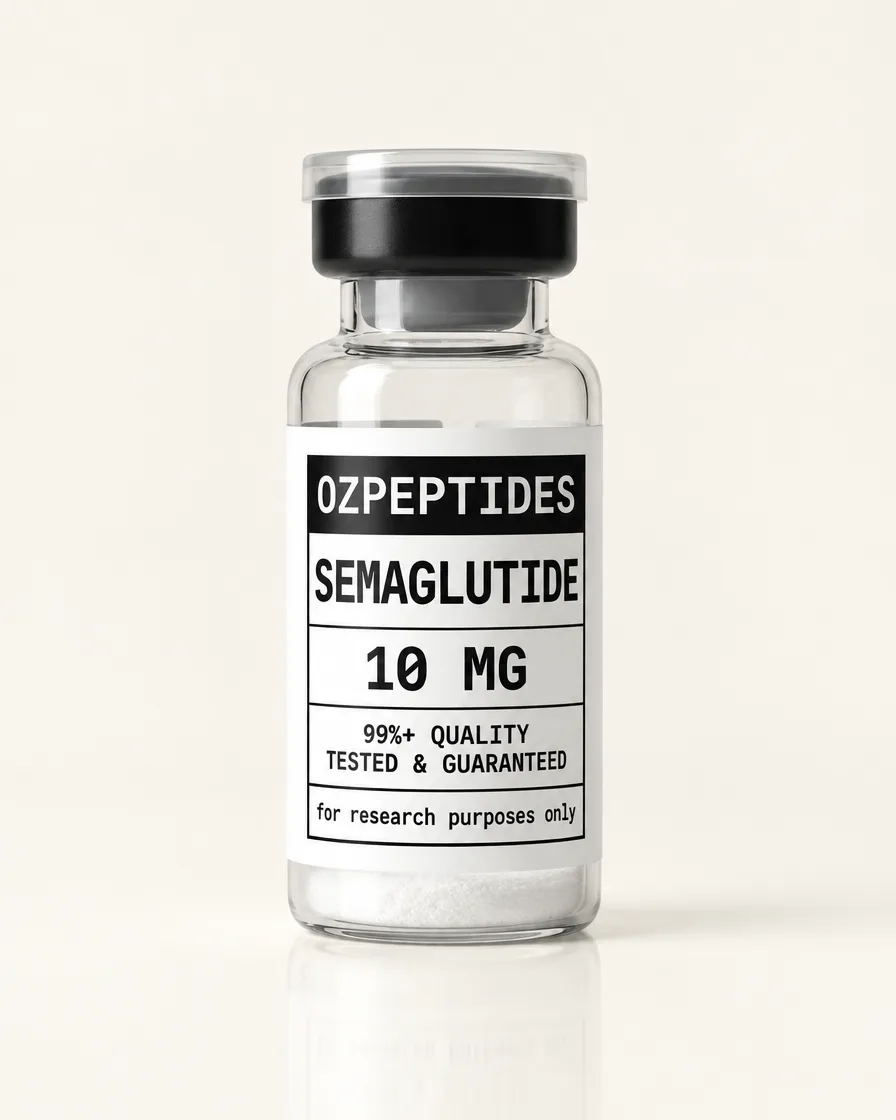
Research-grade semaglutide, made in Australia.
Synthesised and batch-tested in our own Australian lab: ≥99% HPLC purity, identity confirmed by mass spec, 0 ppm heavy metals, and the results recorded against the batch on your vial in your hand.
Frequently asked
Not as a medicine. Research-grade semaglutide is a laboratory reagent supplied for in-vitro work to buyers aged 18 and over, and is not a substitute for a prescription product.
Semaglutide is the molecule. Ozempic and Wegovy are Novo Nordisk's registered products containing it; research-grade material is a laboratory reagent, not either of them.
A substitution at position 8 resists DPP-4, and a fatty-acid chain binds albumin, shielding the molecule from clearance and releasing it slowly.
A 2023 cardiovascular outcome trial of semaglutide. It measured events rather than surrogate markers, which no other incretin compound here has.
Same molecule, oral formulation. It uses an absorption enhancer to survive the gut, and is a registered medicine rather than a research material.
A GLP-1 receptor agonist peptide, modified from native GLP-1 so that it resists enzymatic breakdown and lasts about a week.
Semaglutide acts on the GLP-1 receptor only. Tirzepatide acts on both GIP and GLP-1.
Semaglutide is available in 10MG and 20MG, as a vial, pre-mixed or in a pen cartridge, with mixing at no extra cost (or $5 more per vial while a sale is running).
In our own Australian lab, with ≥99% HPLC purity, mass-spec identity confirmation and the results recorded against the batch.
- Marso SP, et al. Semaglutide and Cardiovascular Outcomes in Patients with Type 2 Diabetes (SUSTAIN-6). N Engl J Med 2016;375:1834–1844.
- Wilding JPH, et al. Once-Weekly Semaglutide in Adults with Overweight or Obesity (STEP 1). N Engl J Med 2021;384:989–1002.
This guide summarises published research for educational purposes. It is not medical advice. OzPeptides products are sold for research and laboratory use only, not for human consumption. 18+ only.