Key facts
What is cagrilintide?
Cagrilintide is a modified version of amylin, the hormone the pancreas co-secretes with insulin after a meal.
Native human amylin is difficult to work with: it aggregates readily, which is a problem both for stability and for formulation. Cagrilintide is engineered around that, with sequence changes for solubility and a fatty-acid chain that extends its half-life to support weekly rather than mealtime administration. It is often described as a "second axis" compound — not an incretin at all, but a different signal entirely.
How does cagrilintide work?
It acts on amylin and calcitonin receptors in the hindbrain, a satiety route separate from GLP-1 signalling.
Amylin signalling slows gastric emptying and promotes meal termination through the area postrema, a brainstem region outside the blood-brain barrier. Because that pathway is distinct from the GLP-1 receptor route, the two can be studied together without simply doubling the same signal — which is the reasoning behind combination research. Cagrilintide is also non-selective between amylin and calcitonin receptors, and that overlap is itself an area of active study.
What is cagrilintide studied for?
Obesity research, most often in combination with semaglutide as CagriSema.
Published phase 2 work has examined cagrilintide alone and the fixed combination with semaglutide, with the combination attracting most of the attention because it tests whether two separate satiety pathways add up. Phase 3 results for the combination began reporting from 2024. As a single agent, the dataset is much thinner than for the incretin compounds, and laboratory research reflects that — much of it is still characterising receptor behaviour rather than outcomes.
Is cagrilintide approved in Australia?
No. Cagrilintide is investigational and is not registered in Australia.
Neither cagrilintide alone nor the CagriSema combination is a registered medicine in Australia. OzPeptides supplies cagrilintide strictly for in-vitro and laboratory research, to buyers aged 18 and over, and not for human consumption.
How is research-grade cagrilintide quality verified?
HPLC purity, mass-spec identity and heavy-metal screening, batch by batch.
Amylin analogues are prone to aggregation, so handling and storage matter more here than with a robust short peptide — lyophilised material kept cold and dark, reconstituted only as needed under your lab's protocols. Each OzPeptides batch is tested in Australia before release at ≥99% HPLC purity with mass-spec identity confirmation and 0 ppm heavy metals, with the results recorded against that batch number on the vial.
What is amylin, and why does it matter here?
Amylin is a hormone co-secreted with insulin from pancreatic beta cells, involved in gastric emptying, glucagon suppression and satiety signalling.
Amylin is the reason cagrilintide is a different proposition from an incretin compound rather than a variation on one. It acts through amylin and calcitonin receptors rather than GLP-1, which is a separate satiety pathway, and combining the two is the mechanistic argument behind the CagriSema programme. Native human amylin aggregates readily, which is what made it hard to develop as a drug and why analogues exist at all — pramlintide, the approved one, was the first solution to that problem.
What is CagriSema?
Novo Nordisk's combination of cagrilintide with semaglutide, studied as a single product rather than as two compounds.
The combination is where most of cagrilintide's public profile comes from, and it is why the compound appears in metabolic research at all. Pairing an amylin analogue with a GLP-1 analogue targets two satiety pathways at once, which is a different strategy from stacking incretin receptors on one molecule as retatrutide does. Trial results have been reported for the combination; cagrilintide on its own has a thinner record, which is worth keeping separate when reading claims about it.
How much is known about cagrilintide alone?
Less than about the combination. Phase 2 work exists for cagrilintide as a single agent, but most published attention is on CagriSema.
This is a common shape in modern drug development and a common source of confusion: a compound is studied mainly as half of a pair, so its individual record is thinner than its name recognition suggests. Anything claimed about cagrilintide on its own should be traceable to a single-agent study, not borrowed from combination results. Neither cagrilintide nor CagriSema is registered in Australia.
Is cagrilintide prohibited in sport?
It has no approval for human therapeutic use anywhere, which places it under the WADA S0 catch-all.
S0 covers pharmacological substances with no current approval by any governmental regulatory health authority for human use and not otherwise addressed on the list. Cagrilintide fits. Athletes subject to anti-doping rules should treat it as prohibited at all times; the absence of a specific named entry is not an exemption.
How is cagrilintide handled?
Lyophilised and cold for storage; bacteriostatic water for reconstitution, refrigerated, with a practical window of weeks.
Amylin analogues are designed around the aggregation problem that native amylin has, but handling still matters: direct the diluent down the side of the vial and swirl rather than shake, since foaming indicates denatured peptide. Keep the reconstituted vial cold and out of light. The reconstitution calculator carries the per-strength arithmetic for the sizes we stock.
What should be checked in a cagrilintide vial?
Identity by mass spectrometry and the fill weight, as with any expensive peptide sold into a market with no regulator checking it.
Cagrilintide is not as widely counterfeited as the incretin compounds simply because it is less well known, but the same failure modes apply: underfilling, and substitution with something cheaper that tests clean on purity. We make cagrilintide in Blacktown, NSW, and test every batch at ≥99% HPLC purity with 0 ppm heavy metals, with the vial's batch number linked to its certificate.
How cagrilintide differs from pramlintide
Pramlintide was the first amylin analogue to reach approval, and it has to be dosed several times a day. Cagrilintide was designed for a much longer duration.
Pramlintide solved the aggregation problem that makes native human amylin undevelopable, by substituting three residues with proline — a trick borrowed from rat amylin, which does not aggregate. It works, and it is approved, but its short duration makes it awkward. Cagrilintide is the later generation: acylated, so it binds albumin and clears slowly, which is the same strategy semaglutide uses and the reason the two can be paired in one product. Understanding that lineage explains why cagrilintide exists at all when an approved amylin analogue already did.
How to read claims about cagrilintide
Check whether a claimed result comes from a single-agent study or from the CagriSema combination. The two are routinely conflated.
A compound studied mainly as half of a pair accumulates a reputation its own data does not support, and cagrilintide is a clear example. Combination results describe what cagrilintide plus semaglutide did together; they cannot be attributed to either component. The same care applies to timelines: a trial reported for the combination is not a trial of cagrilintide. Anything stated about the single agent should trace to a study of the single agent, and where that study does not exist, the honest answer is that the question has not been addressed.
Research-grade cagrilintide, made in Australia.
Synthesised and tested in our own lab here: ≥99% HPLC purity, mass-spec identity, 0 ppm heavy metals, tested batch by batch.
Frequently asked
Pramlintide is short-acting and approved; cagrilintide is acylated to bind albumin and clear slowly, which is why it can be paired with semaglutide in one product.
No. Combination results describe the pair. Claims about the single agent should trace to single-agent studies.
Amylin and calcitonin receptors — a different satiety pathway from the GLP-1 and GIP receptors the incretin compounds use.
Novo Nordisk's combination of cagrilintide with semaglutide, studied as a single product. Most published data on cagrilintide comes from that programme.
No. Neither cagrilintide nor CagriSema is registered in Australia or elsewhere. It is investigational, and supplied here for research and laboratory use only.
Native human amylin aggregates readily, which made it undevelopable as a drug. Analogues exist to solve that.
A long-acting analogue of the pancreatic hormone amylin, engineered for stability and a longer half-life than the native hormone.
Semaglutide acts on the GLP-1 receptor. Cagrilintide acts on amylin and calcitonin receptors — a separate satiety pathway, which is why the two are studied together.
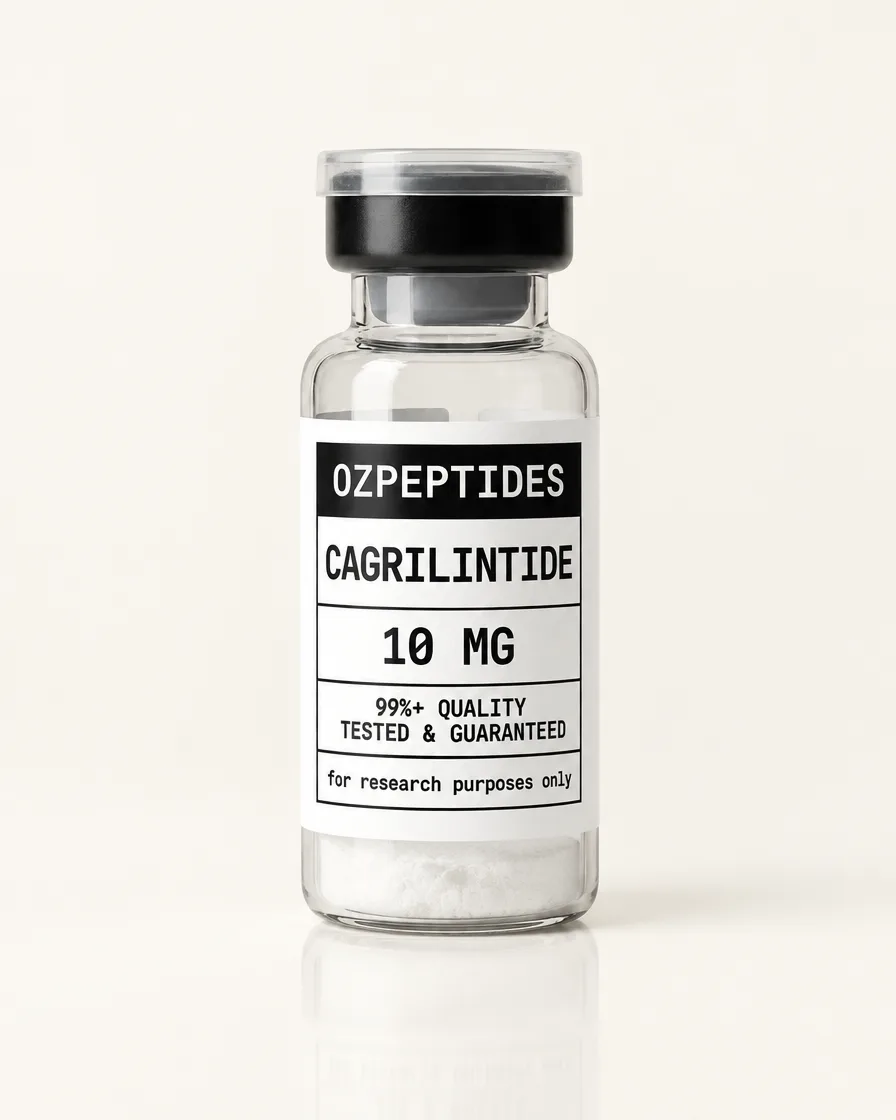
Cagrilintide is available in 10MG, as a vial, pre-mixed or in a pen cartridge, with mixing at no extra cost (or $5 more per vial while a sale is running).
- Lau DCW, et al. Once-weekly cagrilintide for weight management in people with overweight and obesity: a multicentre, randomised, double-blind, placebo-controlled and active-controlled, dose-finding phase 2 trial. Lancet 2021;398:2160–2172.
- Enebo LB, et al. Safety, tolerability, pharmacokinetics, and pharmacodynamics of concomitant administration of multiple doses of cagrilintide with semaglutide 2·4 mg for weight management. Lancet 2021;397:1736–1748.
This guide summarises published research for educational purposes. It is not medical advice. OzPeptides products are sold for research and laboratory use only, not for human consumption. 18+ only.