Key facts
What is Pinealon?
Pinealon is a synthetic tripeptide developed as part of a long-running Russian programme on short "bioregulator" peptides derived from tissue extracts.
The same group produced epithalon, and the two compounds share a research philosophy: that very short peptides derived from organ extracts can regulate gene expression in the tissues they came from. Pinealon is the brain-associated member of that set. Three residues make it one of the smallest compounds in our range and among the simplest to synthesise.
How is Pinealon proposed to work?
The programme's proposed mechanism is direct binding to DNA promoter regions, influencing gene expression.
Published work from the originating group describes short peptides entering cells and nuclei and interacting with specific DNA sequences. Other reported effects include reduced markers of oxidative stress and improved neuronal survival in hypoxia models. This mechanism is not broadly accepted outside the group that proposed it, and the sensible position for a researcher is to treat it as a hypothesis under test.
What is Pinealon studied for?
Neuroprotection, hypoxia models, and age-related cognitive change.
The published work includes rodent hypoxia and oxidative stress models and cell culture studies on neuronal survival, largely from the originating institute. Independent replication is limited, and the international literature on this compound is small. As with epithalon: interesting, narrowly sourced, and better described as early-stage than as established.
Is Pinealon approved in Australia?
No. It is not registered as a medicine here or elsewhere.
Pinealon is not registered in Australia and falls within the WADA S0 catch-all for athletes. OzPeptides supplies it for in-vitro and laboratory research only, 18+, not for human consumption.
How is research-grade Pinealon quality verified?
HPLC purity, mass-spec identity, heavy-metal screening per batch.
A tripeptide is trivial to synthesise, so purity should be high and the real questions are identity and fill weight. Our batches are made and tested in Australia at ≥99% HPLC purity with 0 ppm heavy metals, and the batch record states what is in the vial rather than what is on the label.
What is Pinealon?
A synthetic tripeptide — Glu-Asp-Arg — from the Russian peptide bioregulator tradition, associated with the pineal gland and brain tissue.
Pinealon comes from the same research programme as epithalon: Vladimir Khavinson's group in St Petersburg, working on the premise that short peptides derived from specific tissues regulate those tissues. Where epithalon is a tetrapeptide associated with the pineal gland, Pinealon is a tripeptide associated with brain tissue more broadly. The design logic is consistent across the family, and so is the evidence problem.
What is a peptide bioregulator?
A concept from the Khavinson tradition: that short peptides isolated from a tissue act as regulators of gene expression in that same tissue.
The proposed mechanism is that these very short peptides enter cells and nuclei and interact with DNA directly, influencing transcription in a tissue-specific way. That is an unusual claim, and the support for it comes overwhelmingly from within the originating tradition. Molecular biology outside that tradition has not adopted the framework, and the specificity claim in particular — that a tripeptide from the pineal preferentially regulates pineal genes — has not been demonstrated in independent laboratories.
How strong is the Pinealon evidence?
Weak by international standards. The literature comes almost entirely from the originating group and its collaborators, with essentially no independent replication.
Volume and weight are different things. There are published papers reporting neuroprotective effects in hypoxia and ischaemia models, effects on oxidative stress markers, and behavioural findings in aged animals. They come from one tradition, are published largely in venues with limited international indexing, and have not been reproduced by unaffiliated laboratories. That combination means the paper count overstates how well established any of it is, which is the honest reading rather than a dismissal.
How does Pinealon differ from epithalon?
Different sequence and different tissue association. Epithalon is the tetrapeptide Ala-Glu-Asp-Gly associated with the pineal; Pinealon is the tripeptide Glu-Asp-Arg associated with brain tissue.
They are siblings from the same programme and are often discussed together, but they are distinct molecules with distinct reported profiles, and the telomerase claims attached to epithalon do not transfer to Pinealon. Reading across between them because they come from the same tradition is the same error as reading Semax data onto its analogues: family resemblance is a weak basis for transferring findings.
Is Pinealon prohibited in sport?
It has no approval for human therapeutic use in any Western jurisdiction, which places it under the WADA S0 catch-all.
S0 covers pharmacological substances with no current approval by any governmental regulatory health authority for human therapeutic use and not addressed elsewhere on the Prohibited List. Pinealon has no such approval, and its standing within the Russian research tradition does not change that. Athletes subject to anti-doping rules should treat it as prohibited at all times.
What is Pinealon's status in Australia?
Not registered in Australia. Supplied for in-vitro and laboratory research only, to buyers aged 18 and over.
Pinealon has never been assessed for use in Australia, and no approved product containing it exists here. Registration elsewhere, where it exists, carries no weight in Australia — a drug approved in one jurisdiction is simply not approved in another, and that principle applies regardless of how the compound is regarded in its country of origin.
How is Pinealon stored and reconstituted?
Lyophilised and cold for storage; bacteriostatic water for reconstitution, refrigerated, with a practical window of weeks.
Bacteriostatic water rather than sterile water is what makes a multi-draw vial possible, since the benzyl alcohol inhibits bacterial growth where sterile water offers no protection. Direct the diluent down the side of the vial and swirl rather than shake: foaming is a reliable sign of denatured peptide. Keep the reconstituted vial refrigerated and out of light. A tripeptide is about as robust as a peptide gets and dissolves readily with no special handling. The reconstitution calculator is pre-filled per SKU, so the concentration and the units on a standard insulin syringe come from the vial in hand rather than a generic worked example.
What should be checked in a Pinealon vial?
Identity by mass spectrometry and purity by HPLC. A tripeptide is trivially cheap to synthesise well, so a genuine batch should test essentially clean.
That simplicity means a mediocre purity figure says something about the supplier rather than the chemistry, and it also means there is little incentive to adulterate — which shifts the realistic failure toward underfilling, invisible to purity testing. The other risk with a family of similar short peptides from one tradition is substitution of a sibling compound, which mass spectrometry resolves and nothing else does. We make Pinealon in Blacktown, NSW, at ≥99% HPLC purity with 0 ppm heavy metals.
How to weigh a single-tradition literature
Ask who replicated it. Publication volume from one research programme, in venues that are not internationally indexed, does not accumulate into established knowledge.
The peptide bioregulator literature is a case where the usual heuristics mislead. A search returns many papers, several decades of work and consistent positive findings, which superficially resembles a well-supported field. What it lacks is the thing that makes a finding durable: independent groups, with no stake in the result, obtaining it again under their own conditions. Replication is not a formality — it is how error, bias and artefact get filtered out, and a literature without it has not been through that filter regardless of how large it is. This applies to Pinealon, to epithalon, and to the tradition generally, and it is a reason to treat these compounds as research subjects with open questions rather than as established tools. Stating it plainly is more useful to a researcher than either enthusiasm or dismissal.
Research-grade Pinealon, made in Australia.
Trivial to synthesise, which makes identity and fill the whole question — both recorded against the batch, from our own lab.
Frequently asked
Not on its own. Without independent replication by unaffiliated groups, publication volume from one tradition has not been through the filter that makes findings durable.
A concept from the Khavinson tradition: that short tissue-derived peptides regulate gene expression in that same tissue. It is not an adopted framework outside that tradition.
Different sequence and tissue association — Glu-Asp-Arg for brain tissue against Ala-Glu-Asp-Gly for the pineal. Claims about one do not transfer.
Essentially not. The literature comes from the originating group and collaborators, in venues with limited international indexing.
No. It is not registered in Australia and is supplied for laboratory research only.
A synthetic tripeptide (Glu-Asp-Arg) from the Russian short-peptide bioregulator programme, studied for neuroprotection.
Not broadly. It is proposed by the originating group and not widely independently confirmed.
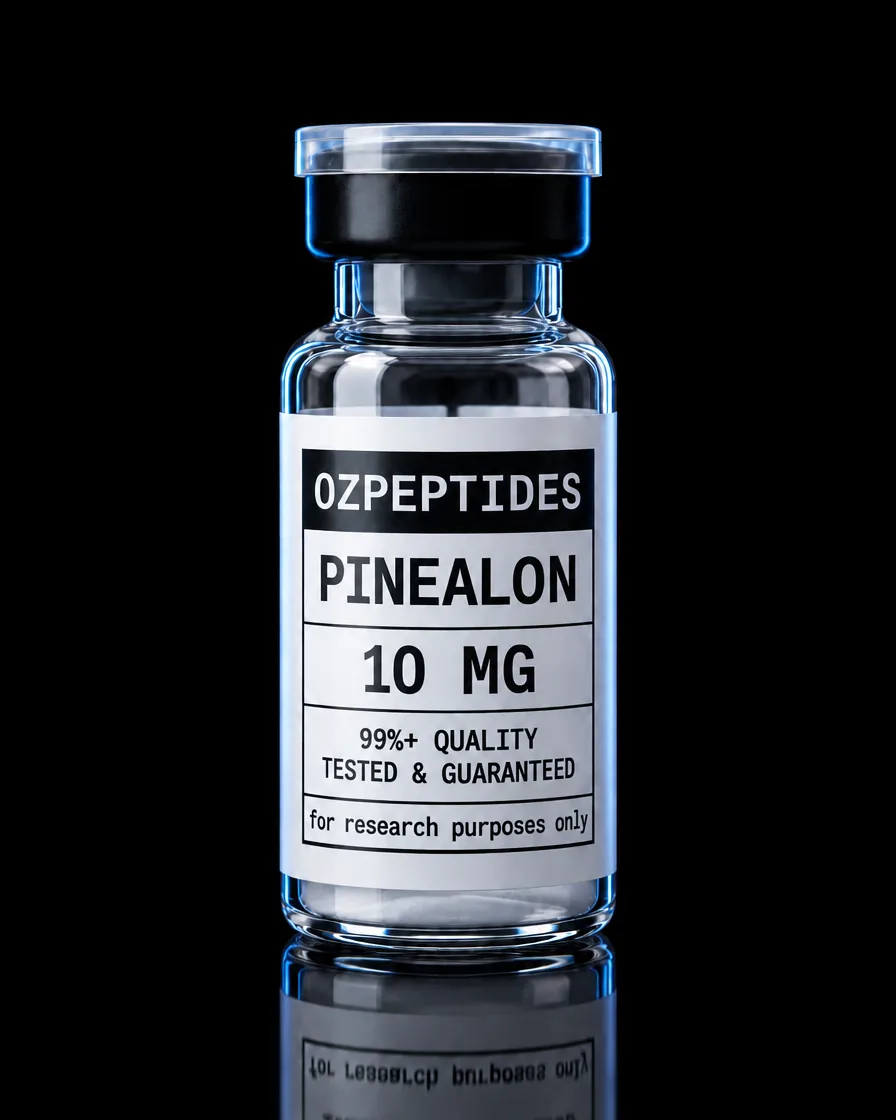
Pinealon is available in 10MG.
- Khavinson VKh, et al. Short peptides regulate gene expression. Bull Exp Biol Med 2016;162:288–292.
- Kolchina N, et al. Systematic search for structural motifs of peptide binding to double-stranded DNA. Nucleic Acids Res 2019;47:10553–10563.
This guide summarises published research for educational purposes. It is not medical advice. OzPeptides products are sold for research and laboratory use only, not for human consumption. 18+ only.