Key facts
What is Cerebrolysin?
Cerebrolysin is a standardised mixture produced by enzymatic breakdown of purified pig brain proteins, not a defined single compound.
That distinction runs through everything about it. It contains short peptides and free amino acids in proportions controlled by the manufacturing process rather than by synthesis, so batch consistency depends on process control rather than on a structure you can verify by mass. It is the only biologically derived preparation in our range; everything else is chemically synthesised.
How is Cerebrolysin proposed to work?
It is described as having neurotrophic activity, with proposed effects mimicking endogenous neurotrophic factors.
Published work reports effects on neuronal survival, synaptic plasticity and neurogenesis in models, with the proposed explanation being that its peptide fraction acts similarly to neurotrophic factors such as BDNF and GDNF. Because it is a mixture, attributing activity to any component is difficult, and the mechanism literature is correspondingly less precise than for a single molecule.
What is Cerebrolysin studied for?
Ischaemic stroke, vascular dementia, Alzheimer's disease and traumatic brain injury.
There is a large clinical literature, including multi-centre randomised trials in acute stroke. The Cochrane reviews are the reference point: analyses of acute ischaemic stroke found no evidence of benefit on death or dependency and noted an imbalance in serious adverse events, while reviews in vascular dementia described limited evidence. Being straight about that matters more than the volume of positive individual trials.
Is Cerebrolysin approved in Australia?
No. It is registered in various other countries but not here.
Cerebrolysin is not registered in Australia. Being an animal-derived biological preparation also puts it in a different regulatory category from synthetic peptides. OzPeptides supplies it for in-vitro and laboratory research only, 18+, not for human consumption.
How is research-grade Cerebrolysin quality verified?
By peptide profile and contaminant screening, since a single-compound purity figure does not apply.
You cannot state "99% pure" for a mixture — the question is whether the profile matches specification and whether contaminants are absent. Our testing covers the peptide profile and screens for heavy metals, with the results recorded against that batch. If a supplier quotes a single HPLC purity number for Cerebrolysin, that alone should tell you something.
What is Cerebrolysin?
Not a single peptide. It is a mixture of low-molecular-weight peptides and amino acids produced by enzymatic breakdown of purified porcine brain protein.
That composition is the most important fact about it and the thing that sets it apart from everything else in this catalogue. Cerebrolysin is a biological preparation with a defined manufacturing process rather than a defined molecule, standardised by that process and by biological activity rather than by a chemical structure. Comparing it to a synthetic peptide is a category error: questions about sequence, molecular weight and HPLC purity that make sense for a defined peptide do not translate.
How is Cerebrolysin reported to work?
As a neurotrophic preparation, with reported activity described as similar to endogenous neurotrophic factors such as BDNF, GDNF and NGF.
The proposed mechanism is that the peptide fragments mimic or potentiate neurotrophic signalling, supporting neuron survival and plasticity. Preclinical work reports effects on neurite outgrowth, on neuroprotection in ischaemia models, and on amyloid processing in Alzheimer's models. Because the preparation is a mixture, attributing any effect to a specific component is not generally possible, which is a real limitation on how mechanistic the evidence can ever be.
What does the clinical evidence show?
More clinical research than almost anything else here, with inconsistent results. Cochrane reviews of its use in ischaemic stroke and vascular dementia have found the evidence insufficient to support routine use.
That combination — substantial trial volume, unconvincing synthesis — is a genuinely informative position and worth stating precisely. Cerebrolysin has been studied in stroke, traumatic brain injury, vascular dementia and Alzheimer's disease, in trials run across Europe and Asia over decades. Systematic reviewers have repeatedly noted heterogeneity, risk of bias and inconsistent effect estimates. It is registered as a medicine in a number of countries, which is a regulatory fact rather than a resolution of the evidence question.
Where is Cerebrolysin approved?
In a number of countries across Europe and Asia, as a prescription medicine. It is not registered in Australia.
Approval in one jurisdiction carries no weight in another, and Australia has not registered Cerebrolysin. It is also worth noting what a registered product is: a specific formulation from a specific manufacturer, made under pharmaceutical standards, with a regulator behind each batch. Research-grade material is not that product, and a preparation derived from animal tissue raises sourcing and consistency questions that a synthetic peptide does not.
Does the porcine origin matter?
Yes, in several ways: sourcing and viral safety, batch-to-batch consistency, and acceptability for anyone avoiding animal-derived products.
A preparation made by enzymatically digesting animal brain tissue carries a different risk and quality profile from a synthesised molecule. Manufacturers address this with controlled sourcing and processing, and it is the reason Cerebrolysin is defined by its process rather than its composition. For anyone evaluating it, the process is the product — which means the provenance of a given preparation matters more than for any synthetic compound on this site.
Is Cerebrolysin prohibited in sport?
It is not named on the WADA Prohibited List. As a preparation containing growth-factor-like activity, its classification is not entirely straightforward.
S2 covers growth factors and related substances affecting several tissue types, and a preparation described as neurotrophic sits close to that language. The list is revised annually and does not name Cerebrolysin. An athlete subject to the Code should check the current list directly and treat a preparation with neurotrophic claims as carrying real classification risk rather than assuming the absence of a name settles it.
How is a peptide mixture quality-assessed?
Differently from a synthetic peptide. Standardisation is by manufacturing process and biological activity, not by HPLC purity against a single molecule.
A purity figure is meaningless for a preparation that is deliberately a mixture: there is no single species for it to be a fraction of. What matters instead is process control, consistency between batches, and contaminant screening including for the risks specific to animal-derived material. A certificate presenting a percentage purity for Cerebrolysin is applying the wrong framework, and that mismatch is itself a signal worth noticing.
How does Cerebrolysin compare with the synthetic nootropic peptides?
It is a different category. Semax and Selank are single defined molecules with thin but specific literatures; Cerebrolysin is a mixture with a large but inconclusive clinical record.
The comparison is genuinely useful because the two illustrate opposite evidence problems. A defined molecule studied in a research tradition that has not been replicated internationally gives you clarity about what the compound is and uncertainty about what it does. A mixture studied extensively in international trials gives you uncertainty about what the compound is and a large but unconvincing body of evidence about what it does. Neither problem is solved by the other.
How to read a large but inconclusive trial literature
Count the trials less and look at what the systematic reviewers said about them. Heterogeneity and risk of bias are why a large body of work can still fail to settle a question.
Cerebrolysin is the best example in this catalogue of evidence that is abundant without being decisive, and understanding why is more useful than any single result. Trials differ in population, dose, duration and outcome measure, which makes them hard to pool; many are small; some are industry-sponsored without independent replication; and outcome scales in stroke and dementia research are notoriously sensitive to how they are analysed. When reviewers describe a literature as heterogeneous with risk of bias, they are saying the studies cannot be combined into a reliable answer, not that the compound has been disproven. The correct conclusion from that is uncertainty, which is an uncomfortable place to sit and the accurate one. It also means a page citing a positive individual trial for Cerebrolysin is not lying and is not telling you much either.
Research-grade Cerebrolysin, made in Australia.
A mixture tested as a mixture: peptide profile against specification and contaminant screening, with the results recorded against your batch.
Frequently asked
Because pooling requires comparable studies. Heterogeneity in population, dose and outcome measure means a large literature can still fail to answer the question.
It is a mixture of low-molecular-weight peptides and amino acids from enzymatic breakdown of porcine brain protein, not a single defined molecule.
Reviews in acute ischaemic stroke found no evidence of benefit on death or dependency, and the evidence in vascular dementia was limited; both cited heterogeneity and risk of bias.
No. It is registered in a number of countries in Europe and Asia but is not registered here.
No. Purity is meaningless for a deliberate mixture. Standardisation is by manufacturing process and biological activity.
A preparation of low-molecular-weight peptides and amino acids derived from purified pig brain — a mixture, not a single molecule.
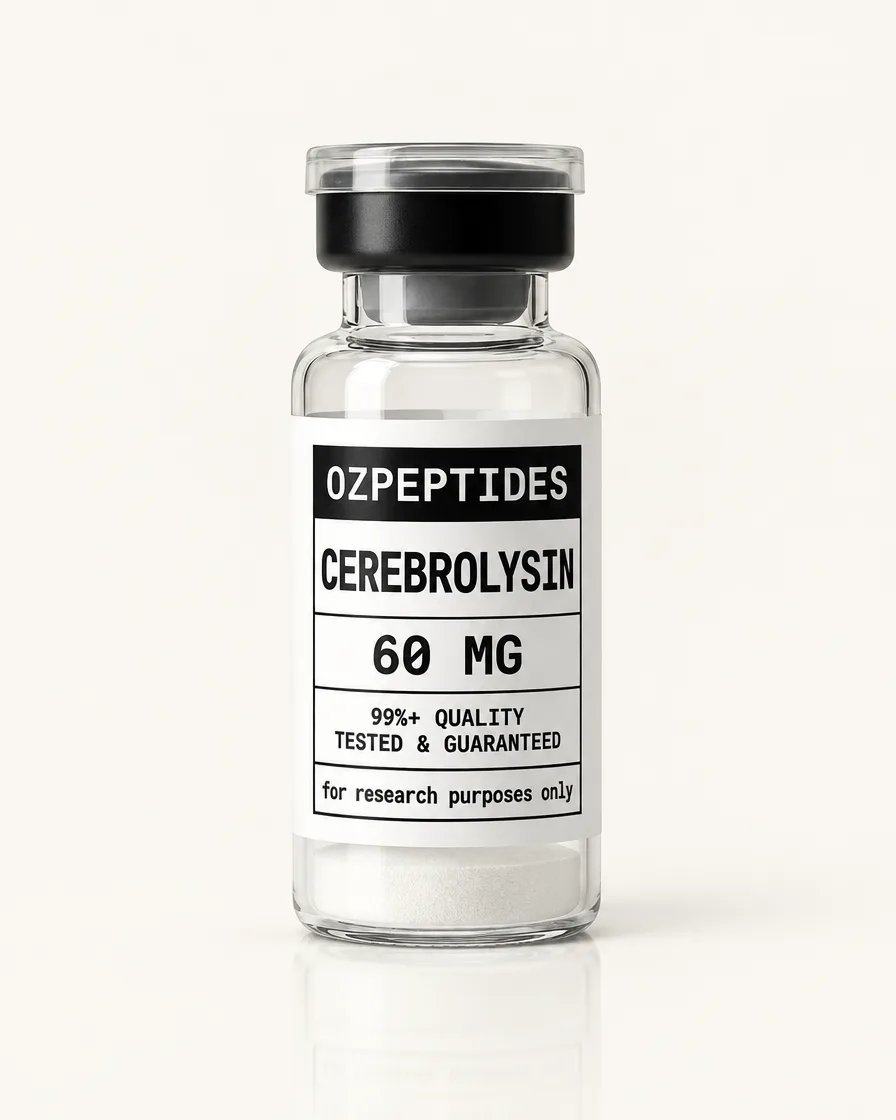
Cerebrolysin is available in 60MG.
- Ziganshina LE, et al. Cerebrolysin for acute ischaemic stroke. Cochrane Database Syst Rev 2020;7:CD007026.
- Cui S, et al. Cerebrolysin for vascular dementia. Cochrane Database Syst Rev 2019;11:CD008900.
This guide summarises published research for educational purposes. It is not medical advice. OzPeptides products are sold for research and laboratory use only, not for human consumption. 18+ only.