Key facts
What is PE-22-28?
PE-22-28 is a shortened, optimised version of spadin — a peptide produced when the sortilin precursor protein is cleaved.
Spadin was identified by French researchers investigating TREK-1, a two-pore potassium channel that had emerged as an antidepressant target after knockout mice showed a depression-resistant phenotype. Spadin blocks that channel. PE-22-28 is a truncated analogue developed for better stability while keeping the blocking activity, which is the version most used in later work.
How does PE-22-28 work?
It blocks the TREK-1 potassium channel, which increases serotonergic neuron excitability in published models.
TREK-1 is a background potassium channel: when open, it keeps neurons hyperpolarised and less likely to fire. Blocking it makes serotonergic neurons in the dorsal raphe more excitable. What makes this interesting in antidepressant research is timing — published rodent work reports behavioural effects and increases in neurogenesis markers within days rather than the weeks associated with SSRIs.
What is PE-22-28 studied for?
Antidepressant mechanism research, neurogenesis and synaptogenesis models.
Published work is rodent-based: behavioural despair models, reported increases in hippocampal neurogenesis, and electrophysiology confirming TREK-1 blockade. There is also work on its effects in stroke models. Human data does not exist. The value of the compound in research is that its target is defined and measurable, which is not true of most peptides marketed as nootropics.
Is PE-22-28 approved in Australia?
No. It is investigational and is not registered in Australia.
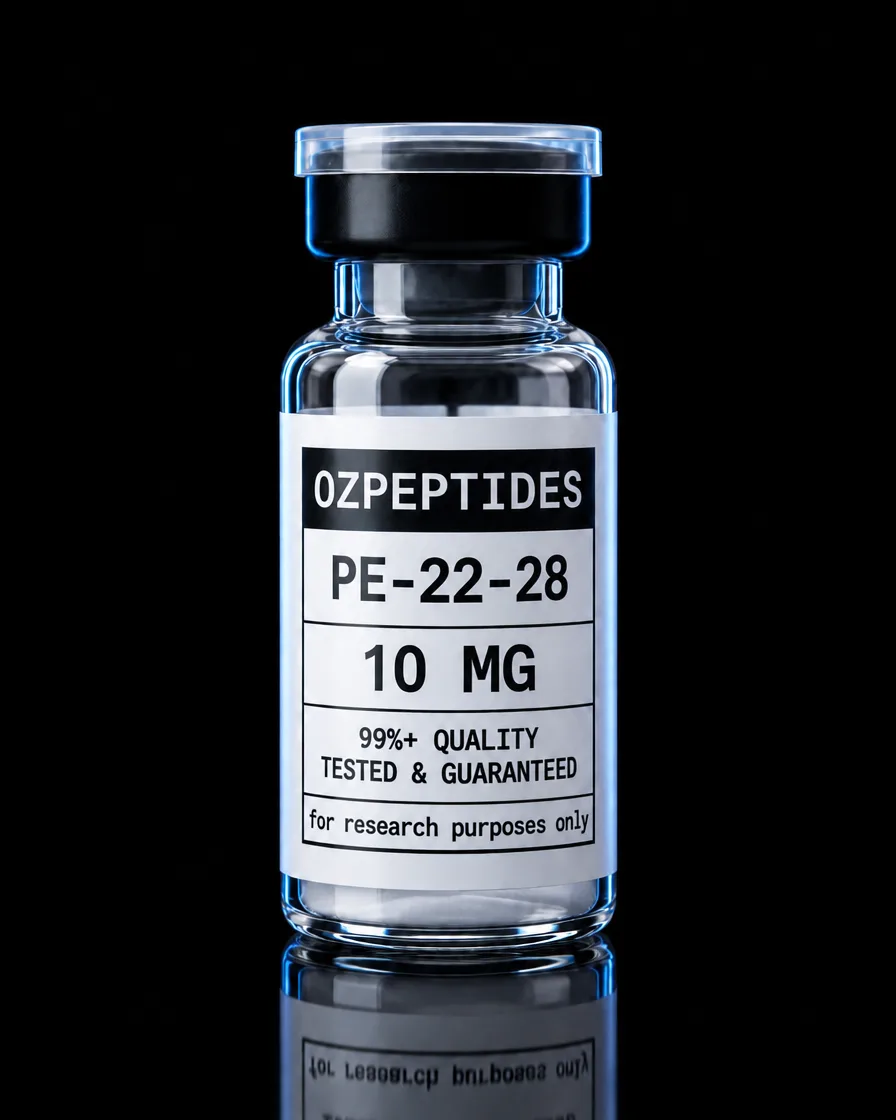
Neither spadin nor PE-22-28 is registered as a medicine anywhere. As a peptide with no approved human therapeutic use it falls within the WADA S0 catch-all. OzPeptides supplies PE-22-28 for in-vitro and laboratory research only, 18+, not for human consumption.
How is research-grade PE-22-28 quality verified?
HPLC purity, mass-spec identity confirmation, heavy-metal screening.
Because the compound is defined by a specific channel-blocking activity that depends on its exact sequence, identity confirmation is not a formality — a close analogue is a different pharmacology. Every OzPeptides batch is made and tested here at ≥99% HPLC purity with 0 ppm heavy metals, results recorded against the batch on your vial.
What is PE-22-28?
A synthetic peptide derived from spadin, itself derived from the propeptide of sortilin, developed as a blocker of the TREK-1 potassium channel.
The lineage is worth following because it explains what kind of compound this is. Sortilin is processed to release a propeptide, spadin, which was found to inhibit TREK-1 — a two-pore-domain potassium channel expressed in the brain. PE-22-28 is a shortened, optimised analogue of spadin developed by French researchers at the Institut de Pharmacologie Moléculaire et Cellulaire. It is a designed channel blocker with a defined molecular target, which distinguishes it from most compounds in this catalogue.
Why target TREK-1?
Because TREK-1 knockout mice show a depression-resistant phenotype, which made the channel a candidate antidepressant target with a fast-acting mechanism.
The genetic evidence is the strongest part of this story. Mice lacking TREK-1 behave in depression models like animals treated with antidepressants, and they show altered serotonergic function — a clean result pointing at the channel as a target. Conventional SSRIs take weeks to act, and a mechanism that could work faster has been a long-standing goal. A TREK-1 blocker is a rational attempt at that, which is a better foundation than most research peptides have.
How strong is the PE-22-28 evidence?
Preclinical. Rodent work from the originating group and collaborators, reporting antidepressant-like effects and neurogenesis in the hippocampus. No human data.
The distinction between a well-founded target and a demonstrated compound matters here. TREK-1 as a target has genetic support; PE-22-28 as a compound has mouse behavioural data and no clinical programme. Rodent depression models are also among the least predictive in pharmacology — the history of antidepressant development is full of compounds that performed in forced-swim and tail-suspension tests and did nothing in people. Both facts belong in an honest account.
What is the relationship to spadin?
PE-22-28 is a shortened analogue. Spadin is the natural propeptide fragment; PE-22-28 was optimised from it for improved stability and activity.
Analogue development from a natural fragment is a standard approach and the same pattern as several compounds here — TB-500 from thymosin beta-4, BPC-157 from body protection compound, KPV from alpha-MSH. The optimisation usually targets stability, since natural fragments are typically cleared quickly. What it means practically is that spadin data and PE-22-28 data are related but not identical, and studies of one should be cited as studies of one.
Is PE-22-28 prohibited in sport?
It has no approval for human therapeutic use anywhere, which places it under the WADA S0 catch-all.
S0 covers pharmacological substances with no current approval by any governmental regulatory health authority for human therapeutic use and not addressed elsewhere on the Prohibited List. PE-22-28 has no approval in any jurisdiction. Athletes subject to anti-doping rules should treat it as prohibited at all times; the absence of a named listing is not an exemption.
What is PE-22-28's status in Australia?
Not registered in Australia. Supplied for in-vitro and laboratory research only, to buyers aged 18 and over.
PE-22-28 has never been assessed for use in Australia, and there is no approved product containing it anywhere in the world. For a compound at the preclinical stage that is the expected position — there has been no registrational programme for a regulator to assess. It is supplied here as a laboratory reagent and nothing more.
How is PE-22-28 stored and reconstituted?
Lyophilised and cold for storage; bacteriostatic water for reconstitution, refrigerated, with a practical window of weeks.
Bacteriostatic water rather than sterile water is what makes a multi-draw vial possible, since the benzyl alcohol inhibits bacterial growth where sterile water offers no protection. Direct the diluent down the side of the vial and swirl rather than shake: foaming is a reliable sign of denatured peptide. Keep the reconstituted vial refrigerated and out of light. The reconstitution calculator is pre-filled per SKU, so the concentration and the units on a standard insulin syringe come from the vial in hand rather than a generic worked example.
What should be checked in a PE-22-28 vial?
Identity by mass spectrometry and purity by HPLC. A poorly known compound has no published reference data for a buyer to check against.
That is the argument for a higher analytical standard rather than a lower one: with a familiar peptide there is community knowledge and published characterisation to compare against, and with an obscure designed analogue there is only the supplier's own work. Substitution with spadin or a related fragment is the realistic identity risk, and no purity assay detects it. We make PE-22-28 in Blacktown, NSW, at ≥99% HPLC purity with 0 ppm heavy metals, with identity confirmed per batch.
Why rodent depression models warrant caution
Because they are among the least predictive assays in pharmacology. Forced-swim and tail-suspension tests detect known antidepressants and also flag compounds that fail in people.
This is worth spelling out, because PE-22-28's evidence rests on exactly these assays. The standard rodent behavioural tests were validated by their ability to detect drugs already known to work in humans, which is circular in a specific way: they are good at recognising compounds resembling existing antidepressants and unreliable at predicting genuinely novel mechanisms. The history of central nervous system drug development is full of compounds that performed well in them and failed in clinical trials, and the attrition rate in psychiatry is the highest of any therapeutic area. None of that makes PE-22-28 uninteresting — the TREK-1 target has independent genetic support, which is the stronger part of the case — but it does mean the behavioural results should be read as consistent with the hypothesis rather than as evidence the compound works. That distinction is the whole difference between a promising target and a demonstrated drug.
Research-grade PE-22-28, made in Australia.
A defined target means the sequence has to be exact — confirmed by mass spec, ≥99% HPLC purity, 0 ppm heavy metals, made here.
Frequently asked
Poorly. They were validated on known antidepressants, which makes them good at recognising familiar mechanisms and unreliable for novel ones.
TREK-1, a two-pore-domain potassium channel in the brain. It is a designed blocker derived from the natural propeptide fragment spadin.
TREK-1 knockout mice show a depression-resistant phenotype with altered serotonergic function, suggesting a potentially fast-acting mechanism.
No. The evidence is rodent behavioural work from the originating group, with no clinical programme.
It is a shortened analogue optimised for stability and activity. Studies of spadin should be cited as studies of spadin.
A seven-amino-acid analogue of spadin that blocks the TREK-1 potassium channel.
A peptide fragment released during processing of the sortilin precursor protein, identified as a natural TREK-1 blocker.
PE-22-28 is available in 10MG.
- Mazella J, et al. Spadin, a sortilin-derived peptide, targeting rodent TREK-1 channels: a new concept in the antidepressant drug design. PLoS Biol 2010;8:e1000355.
- Djillani A, et al. Shortened spadin analogs display better TREK-1 inhibition, in vivo stability and antidepressant activity. Front Pharmacol 2017;8:643.
This guide summarises published research for educational purposes. It is not medical advice. OzPeptides products are sold for research and laboratory use only, not for human consumption. 18+ only.