Key facts
What is SS-31?
SS-31 is a short synthetic peptide designed to accumulate in mitochondria, where it associates with the inner membrane lipid cardiolipin.
Its alternating aromatic and basic residues give it an unusual property: it crosses cell membranes and concentrates in the inner mitochondrial membrane at levels far above the surrounding cytosol, without depending on membrane potential the way earlier mitochondria-targeted compounds did. That targeting is the design achievement — getting a molecule to the right compartment is often harder than making it active.
How does SS-31 work?
It binds cardiolipin and is reported to stabilise the cristae architecture that electron transport depends on.
Cardiolipin is a signature lipid of the inner mitochondrial membrane and is required for the supercomplexes of the electron transport chain to assemble properly. When it becomes peroxidised — a common consequence of oxidative stress — those structures destabilise, efficiency falls, and more reactive species are produced. SS-31 associating with cardiolipin is proposed to interrupt that cycle, improving coupling rather than scavenging radicals directly.
What is SS-31 studied for?
Primary mitochondrial myopathy, Barth syndrome, heart failure and ischaemia-reperfusion research.
Elamipretide has been through registered clinical trials including phase 3 work in primary mitochondrial myopathy and studies in Barth syndrome, alongside earlier work in heart failure and ischaemia-reperfusion injury. Results have been mixed: some endpoints met, others not, and the regulatory path has been long. That is a fuller and more mature evidence base than almost anything else in this range — and it is also not an approval.
Is SS-31 approved in Australia?
No. Elamipretide has been trialled but is not registered in Australia.
The compound remains investigational in Australia. OzPeptides supplies research-grade SS-31 strictly for in-vitro and laboratory research, to buyers aged 18 and over, not for human consumption. Anyone researching mitochondrial disease should be reading the trial literature, which is substantial.
How is research-grade SS-31 quality verified?
HPLC purity, mass-spec identity and heavy-metal screening on every batch.
SS-31 includes the non-standard residue 2',6'-dimethyltyrosine, which is both what makes it work and where a cheap synthesis cuts corners — substituting plain tyrosine gives a peptide of nearly the right mass and the wrong behaviour. Mass spectrometry is what catches that. Every batch is made and tested in our Australian lab at ≥99% HPLC purity with 0 ppm heavy metals and the results recorded against the batch.
What does SS-31 actually target?
Cardiolipin, a phospholipid unique to the inner mitochondrial membrane. SS-31 concentrates there and is reported to stabilise the membrane's structure.
This is what makes SS-31 mechanistically distinctive rather than another generic antioxidant. Cardiolipin has an unusual four-tailed structure found essentially nowhere else, and it organises the respiratory chain complexes into the supercomplexes that make electron transport efficient. It is also easily oxidised, and cardiolipin damage is implicated in mitochondrial dysfunction across a range of disease models. A compound that localises specifically to that lipid is targeting a defined structure rather than scavenging free radicals generally.
What is an SS peptide?
One of a family of small aromatic-cationic peptides developed by Hazel Szeto and Peter Schiller — the SS in the name — designed to concentrate in mitochondria.
The design problem was getting a molecule into the mitochondrial inner membrane, which sits behind two membranes and a steep electrochemical gradient. The SS peptides solve it with an alternating aromatic-cationic motif that drives accumulation there independently of the membrane potential, which matters because a depolarised, damaged mitochondrion is exactly the one you would want to reach. Several members of the family exist; SS-31 is the one that went furthest, as elamipretide.
How far did elamipretide get in clinical research?
Further than almost anything else in this catalogue. It has been studied in Barth syndrome, primary mitochondrial myopathy, dry age-related macular degeneration and heart failure, with published results.
That record is genuinely substantial and includes randomised controlled trials, which most compounds here have never seen. The results have been mixed: a phase 3 trial in primary mitochondrial myopathy did not meet its primary endpoint, while work in Barth syndrome — a very rare cardiolipin-remodelling disorder where the mechanism fits precisely — has been more encouraging and has been the subject of regulatory submission. A serious clinical programme with mixed results is the accurate summary, and it is a different position from the preclinical-only compounds around it.
Why is Barth syndrome the best fit?
Because Barth syndrome is a disorder of cardiolipin remodelling, caused by mutations in the TAFAZZIN gene — the exact structure SS-31 targets.
It is unusual to find a research compound whose mechanism maps onto a genetic disorder that precisely. Tafazzin remodels cardiolipin after it is synthesised, and its loss produces abnormal cardiolipin, mitochondrial dysfunction, cardiomyopathy and neutropenia. A cardiolipin-stabilising peptide is therefore a mechanistically rational candidate rather than a hopeful one, which is why that programme has been the most persistent part of elamipretide's development.
What should be taken from the mixed results?
That a well-designed mechanism does not guarantee a clinical effect, and that a failed primary endpoint is a real result rather than an absence of evidence.
SS-31 is a useful case study for reading this whole catalogue. It has an identified molecular target, a rational design, and randomised trials — and it still did not meet its primary endpoint in primary mitochondrial myopathy. That is how drug development usually goes, and it is a corrective to the assumption that a compelling mechanism implies an effect. It also means SS-31 has something most research peptides lack: real human data, including data that did not go the developer's way.
Is SS-31 prohibited in sport?
It has no regulatory approval for human therapeutic use, which places it under the WADA S0 catch-all.
Elamipretide has orphan and fast-track designations but no approval, and designations are not approvals. S0 covers substances with no current approval by any governmental regulatory health authority for human use, so athletes subject to anti-doping rules should treat SS-31 as prohibited at all times. The mitochondrial and exercise-capacity framing around the compound makes this worth stating explicitly rather than assuming.
How is SS-31 stored and reconstituted?
Lyophilised and cold for storage; bacteriostatic water for reconstitution, refrigerated and dark, with a practical window of weeks.
SS-31 is a four-residue peptide with an unusual aromatic-cationic composition, and it dissolves readily. The standard handling applies: bacteriostatic water rather than sterile so the vial can be drawn from over weeks, diluent directed down the side, swirl rather than shake since foaming indicates denatured peptide, and refrigerate once mixed.
What should be checked in an SS-31 vial?
Identity by mass spectrometry and purity by HPLC. The SS family contains several closely related peptides, so identity is the check that matters.
SS-20, SS-31 and their relatives share a design motif and differ in sequence, which means a purity figure cannot tell you which one is in the vial. Mass spectrometry can. Beyond that the usual failure modes apply: underfilling, invisible to purity testing, and relabelled imported stock whose certificate belongs to a different batch. We make SS-31 in Blacktown, NSW, at ≥99% HPLC purity with 0 ppm heavy metals.
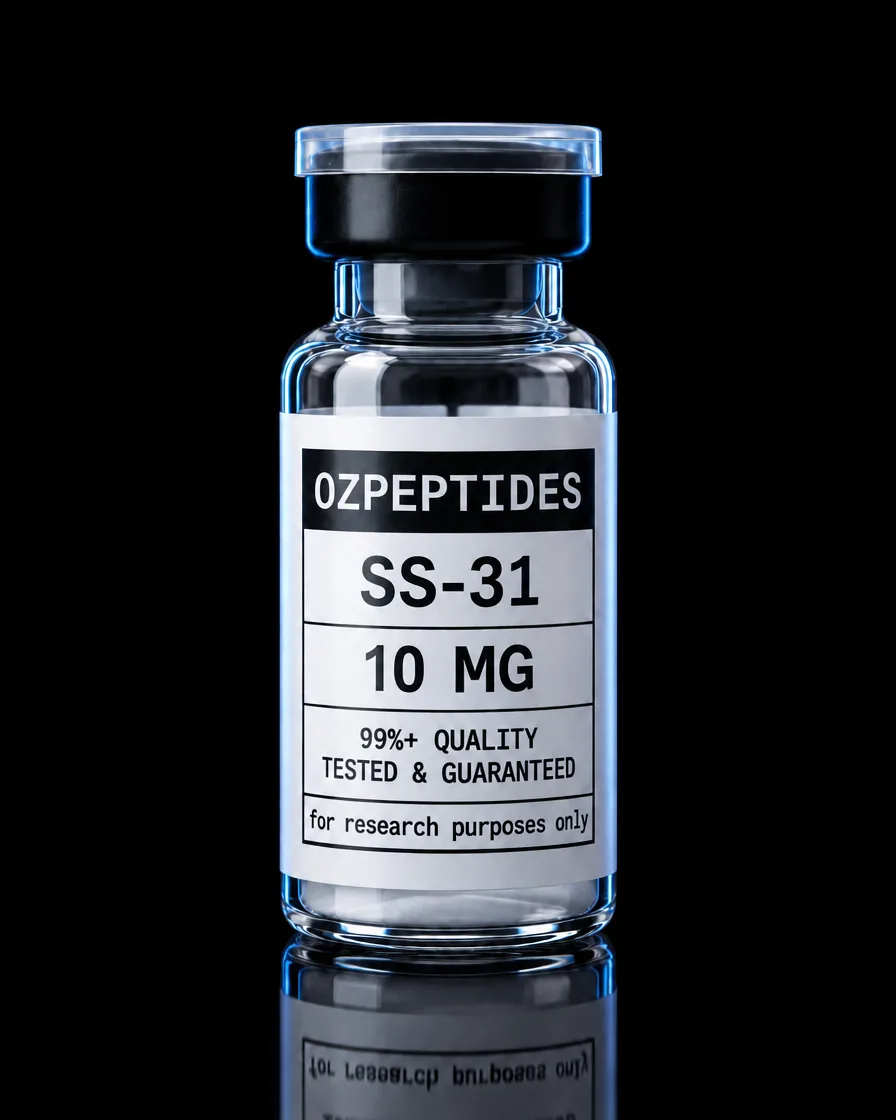
Research-grade SS-31, made in Australia.
A peptide with a non-standard residue that cheap synthesis likes to skip — so we confirm it by mass spec. ≥99% HPLC purity, 0 ppm heavy metals.
Frequently asked
Cardiolipin, a phospholipid unique to the inner mitochondrial membrane, where SS-31 concentrates and is reported to stabilise membrane structure.
Yes. Elamipretide is the development name under which it has been studied in clinical trials.
Mixed. A phase 3 trial in primary mitochondrial myopathy did not meet its primary endpoint; the Barth syndrome programme has been more encouraging.
It is a disorder of cardiolipin remodelling caused by TAFAZZIN mutations — the exact structure SS-31 is designed to stabilise.
A mitochondria-targeted tetrapeptide, also called elamipretide, that binds cardiolipin in the inner mitochondrial membrane.
Its alternating aromatic-basic sequence lets it cross membranes and concentrate in the inner mitochondrial membrane without depending on membrane potential.
No. It remains investigational and is supplied here for research use only.
SS-31 is available in 10MG.
- Birk AV, et al. The mitochondrial-targeted compound SS-31 re-energizes ischemic mitochondria by interacting with cardiolipin. J Am Soc Nephrol 2013;24:1250–1261.
- Karaa A, et al. Randomized dose-escalation trial of elamipretide in adults with primary mitochondrial myopathy. Neurology 2018;90:e1212–e1221.
This guide summarises published research for educational purposes. It is not medical advice. OzPeptides products are sold for research and laboratory use only, not for human consumption. 18+ only.