Key facts
What is BPC-157?
BPC-157 is a laboratory-made fragment of a naturally occurring gastric protein, stable enough to survive in aqueous solution where most short peptides do not.
The parent compound, body protection compound, was isolated from human gastric juice, and BPC-157 is a 15-residue stretch of it synthesised on its own. Its unusual stability in gastric acid is what first drew attention: most peptides of this size degrade quickly, which limits how they can be studied. That property is why it appears so often in oral-administration animal models, and it is also why it turns up in so much low-quality marketing — a stable peptide is easy to sell.
How does BPC-157 work?
The most-reported mechanisms involve angiogenesis and growth-factor signalling, particularly the VEGF and nitric-oxide pathways.
Published animal work associates BPC-157 with increased expression of vascular endothelial growth factor receptor 2 and with effects on nitric-oxide signalling, which together plausibly explain the angiogenic findings reported in tendon, muscle and gut injury models. Several groups have also reported interaction with the dopamine and serotonin systems in rodents. No single receptor has been established as its target, and that gap is one of the fairest criticisms of the field.
What is BPC-157 studied for?
Tendon, ligament, muscle and gut-lining repair models — overwhelmingly in rats and mice.
The published base is large but narrow: hundreds of rodent studies, many from a small number of research groups, covering tendon-to-bone healing, ligament injury, gastrointestinal lesions and inflammatory bowel models. Registered human clinical trials are very few and small. Anyone reading the literature should note the concentration of publications among related authors, which is a real limitation on how confidently the findings can be generalised — and a reason this page does not make claims about people.
Is BPC-157 approved in Australia?
No, and it is explicitly prohibited in sport at all times.
BPC-157 is not registered in Australia. WADA added it by name to the Prohibited List under S0 (non-approved substances), so it is banned in and out of competition for athletes subject to anti-doping rules, including at club level in many sports. OzPeptides supplies BPC-157 strictly for in-vitro and laboratory research, to buyers aged 18 and over, not for human consumption.
How is research-grade BPC-157 quality verified?
HPLC purity, mass-spec identity and heavy-metal screening on every batch.
BPC-157 is widely counterfeited, and the usual problem is not an empty vial but an under-filled or impure one. A 15-residue peptide is a simple synthesis, so a genuine batch should test very clean — anything much below 99% by HPLC deserves a question. Every OzPeptides batch is made and tested here in Australia, with mass-spec identity confirmation, 0 ppm heavy metals, and the results recorded against the batch number on your vial.
Where does BPC-157 come from?
It is a 15-amino-acid sequence derived from body protection compound, a protein found in human gastric juice. BPC-157 is a synthetic fragment, not the whole protein.
The parent protein was identified in the stomach, and the research premise was that a region of it carries protective activity that could be isolated and studied on its own. That gastric origin is not incidental: it is the reason BPC-157 is described in the literature as stable in gastric juice, which is a genuinely unusual property for a peptide and the reason an oral research route exists for it at all. Most peptides are destroyed by digestion within minutes, which is why almost everything else in this catalogue is studied parenterally. The sequence itself does not occur as a free peptide in the body — it is a designed fragment of a natural protein, which is a distinction worth keeping clear when a page describes it as "naturally occurring".
Is there a known BPC-157 receptor?
No. Its reported mechanisms are inferred from downstream observations rather than from an identified binding target.
This is the honest centre of the BPC-157 story and the thing that separates it from compounds like semaglutide, where the receptor is known and the pharmacology follows from it. The published work reports effects — upregulation of VEGF receptor 2 expression, interaction with nitric oxide signalling, effects on growth-factor pathways and on the gut-brain axis — but no paper identifies the molecule BPC-157 binds to produce them. A compound without an identified target is not thereby fake; plenty of useful drugs preceded their mechanism. It does mean the mechanistic claims in circulation are downstream observations, and anyone describing a confirmed receptor is describing something that has not been published.
How strong is the BPC-157 evidence?
Extensive preclinical literature, almost all rodent, from a small number of research groups. Human clinical data is essentially absent.
The volume of published work is real — tendon, ligament, muscle, gut and nerve models across hundreds of papers — and it is the reason BPC-157 has the profile it does. Two limitations qualify it. First, the great majority of it comes from a small cluster of collaborating groups, and independent replication outside that cluster is thin, which is a recognised weakness in any literature regardless of subject. Second, rodent results in healing models translate to humans unreliably; the history of wound-healing research is full of compounds that worked in rats and did nothing in people. Both facts belong in an honest reading, alongside the genuine breadth of the animal work.
Is BPC-157 banned in sport?
Yes. WADA lists it under S0, prohibited at all times, in and out of competition.
S0 covers pharmacological substances with no current approval by any governmental regulatory health authority for human therapeutic use and not addressed elsewhere on the list. BPC-157 fits that description precisely, and WADA added an explicit mention of it to remove any ambiguity. The practical consequences are strict: S0 substances are prohibited at all times, there is no in-competition-only carve-out, and anti-doping laboratories test for it. Any athlete subject to the World Anti-Doping Code should treat BPC-157 as prohibited without qualification, and the fact that it is easy to buy changes nothing about that.
Is BPC-157 studied orally?
Yes, unusually for a peptide. Its reported stability in gastric juice is what makes an oral research route plausible, and several published rodent studies use it.
In most of this catalogue an oral formulation would be a red flag, because peptides are digested. BPC-157 is the exception with an actual basis in the literature — the parent protein is gastric, and the fragment is described as surviving that environment. That said, surviving the stomach and being absorbed intact into circulation are two different problems, and the second is much less well established than the first. Capsule products sold on the strength of the gastric-stability finding are extrapolating past what the research shows, which is a distinction worth holding onto whichever format is being considered.
How is BPC-157 stored and reconstituted?
Lyophilised, cold and dry, it is stable for long periods. Reconstituted with bacteriostatic water and refrigerated, the practical window is weeks.
Bacteriostatic water rather than sterile water is what makes a multi-draw vial possible: the benzyl alcohol in it inhibits bacterial growth, where sterile water offers no such protection and gives a vial that should be used once. Direct the diluent down the side of the vial and swirl rather than shake, since foaming is a sign of denatured peptide. Keep the reconstituted vial refrigerated and out of light. A 10MG vial in 2ML of bacteriostatic water is 5MG/ML, so a 0.1ML draw on an insulin syringe is 500mcg; the reconstitution calculator carries the arithmetic for each strength we stock rather than a generic example.
What should be checked in a BPC-157 vial?
Identity by mass spectrometry, purity by HPLC, and the fill weight. All three, because each catches a different failure.
BPC-157 is a short, inexpensive synthesis, which has two consequences. A genuine batch should test very clean, so a mediocre purity figure on this compound says something about the supplier rather than about the chemistry. And because the peptide itself is cheap, the common grey-market failure is not adulteration but underfilling — a vial containing a fraction of its stated weight, which passes a purity test without trouble because purity is a fraction of what is present, not a measure of how much. We make BPC-157 in Blacktown, NSW, and test every batch here at ≥99% HPLC purity with 0 ppm heavy metals, with the vial batch number resolving to its certificate.
BPC-157 vs TB-500 vs the Wolverine Stack
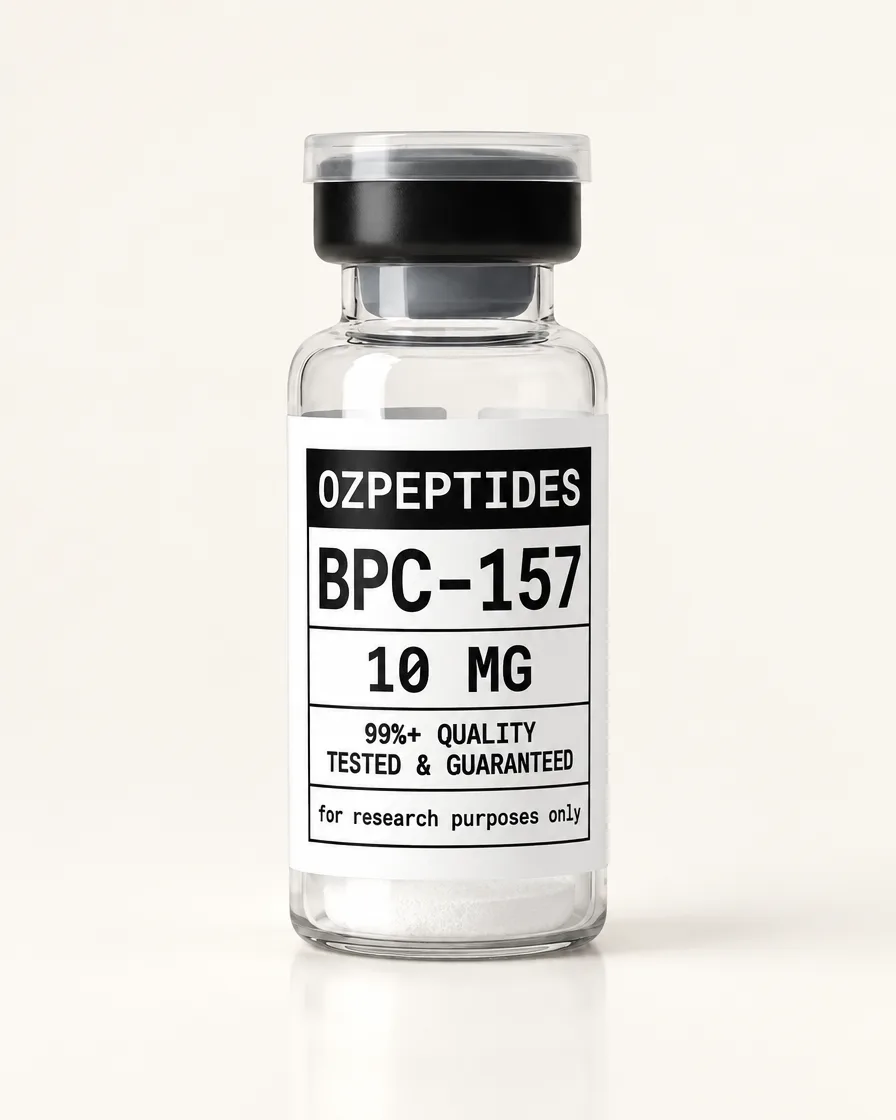
Research-grade BPC-157, made in Australia.
The most counterfeited peptide on the market, made in our own lab instead: ≥99% HPLC purity, mass-spec identity, 0 ppm heavy metals, tested batch by batch.
Frequently asked
No. Its reported mechanisms come from downstream observations such as VEGF receptor 2 expression, not from an identified binding target.
Yes. WADA lists it under S0, prohibited at all times, in and out of competition. Laboratories test for it.
Essentially none. The literature is extensive but almost entirely rodent work, largely from a small number of collaborating groups; registered human trials are few and small.
It is described in the literature as stable in gastric juice, inherited from its gastric parent protein. Surviving the stomach and being absorbed intact are still separate questions.
A synthetic 15-amino-acid peptide based on a sequence found in human gastric juice, studied in soft-tissue and gut repair research.
BPC-157 is available in 10MG and 20MG, as a vial, pre-mixed or in a pen cartridge, with mixing at no extra cost (or $5 more per vial while a sale is running).
The batch number printed on the vial identifies exactly which batch it came from, and that batch was tested here for HPLC purity, mass-spec identity and heavy metals before release.
- Sikiric P, et al. Stable gastric pentadecapeptide BPC 157: novel therapy in gastrointestinal tract. Curr Pharm Des 2011;17:1612–1632.
- Chang CH, et al. The promoting effect of pentadecapeptide BPC 157 on tendon healing involves tendon outgrowth, cell survival, and cell migration. J Appl Physiol 2011;110:774–780.
- World Anti-Doping Agency. Prohibited List — Section S0, Non-Approved Substances.
This guide summarises published research for educational purposes. It is not medical advice. OzPeptides products are sold for research and laboratory use only, not for human consumption. 18+ only.